
SARA vs WebMotion
Comprehensive feature analysis, ratings breakdown, platform compatibility, and community review comparison.
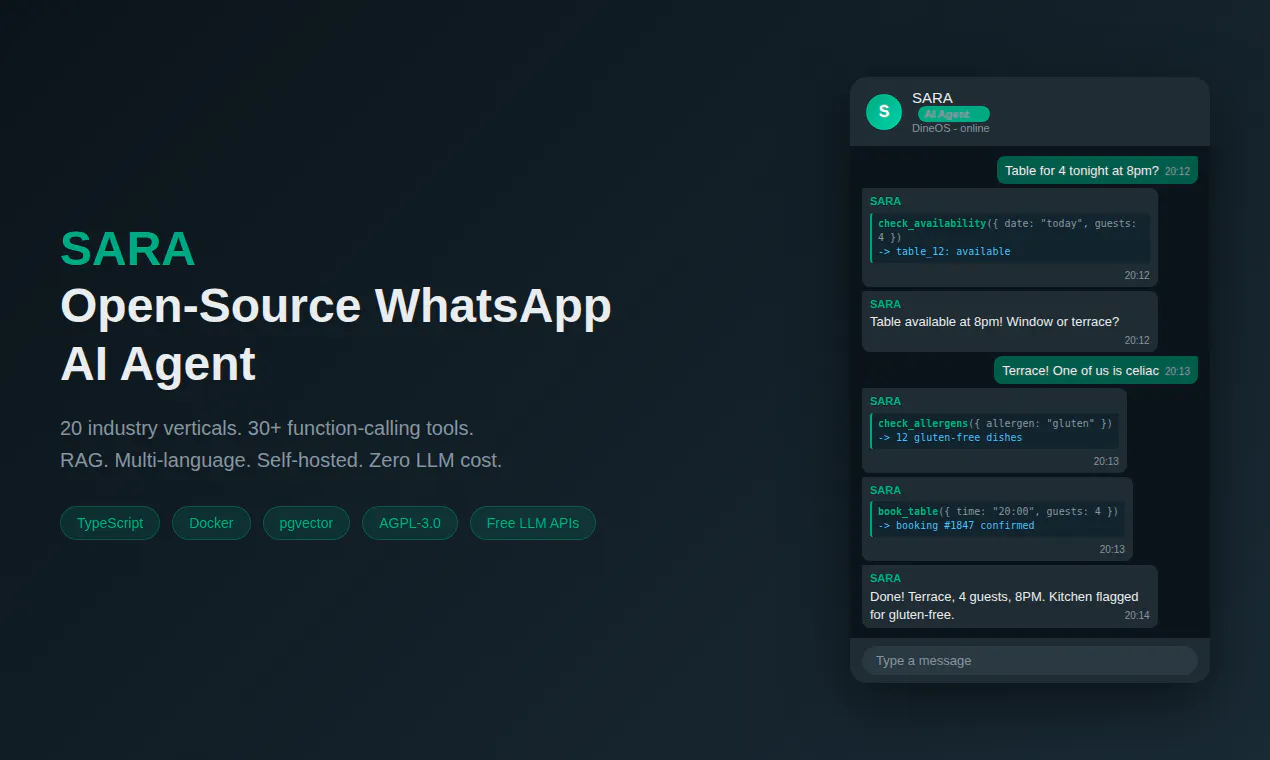
SARA
Open-source WhatsApp AI agent - 20 industry-specific brains
Detailed Feature Comparison Matrix
Compare Other Tools| Dimension | SARA |  WebMotion WebMotion |
|---|---|---|
| Primary Category | Open Source | Open Source |
| Community Rating | No ratings(0 reviews) | No ratings(0 reviews) |
| Community Upvotes | 7 votes | 5 votes |
| Supported Platforms | Web | Web |
| Tags & Focus | #Artificial Intelligence#Open Source#SaaS#GitHub | #Open Source#GitHub#Video#OpenAI Day |
| Maker / Company | Independent Developer | Independent Developer |
| Platform Verification | Community Listing | Community Listing |
About SARA
SARA is an open-source, self-hostable AI agent designed specifically for WhatsApp. Released under the AGPL-3.0 license by developer Alessandro Binda, SARA provides businesses with a customizable conversational assistant that operates natively on the WhatsApp platform.
Built to handle context-aware business interactions, SARA comes equipped with 20 industry-specific brains tailored for various verticals, including restaurants, medical clinics, real estate agencies, and beauty salons. The platform leverages advanced features like Retrieval-Augmented Generation (RAG), multi-language support, and function calling powered by over 30 integrated tools.
SARA is designed for easy deployment and cost-efficient scaling. It works out of the box with Docker Compose for local self-hosting or cloud deployment, and connects seamlessly with high-speed, free LLM inference providers such as Groq, Cerebras, and SambaNova.
Pros of SARA
- Open-source software licensed under AGPL-3.0
- Pre-packaged with 20 industry-specific brains (e.g., clinics, real estate, restaurants)
- Supports function calling with 30+ tools and RAG capabilities
- Integrates with free LLM inference providers like Groq, Cerebras, and SambaNova
- Simple deployment out of the box using Docker Compose
Cons of SARA
- Requires technical infrastructure setup for Docker self-hosting
- Deployment and management currently focused primarily on WhatsApp
Frequently Asked Questions
What is SARA?
SARA is an open-source, self-hostable AI agent designed for WhatsApp. It helps businesses automate communication using pre-configured industry-specific models and tools.
What industries does SARA support out of the box?
SARA includes 20 industry-specific brains tailored for verticals such as restaurants, healthcare clinics, real estate, and salons, among others.
How do I deploy SARA?
SARA can be self-hosted using Docker Compose out of the box, or configured to run in the cloud.
Which LLM providers work with SARA?
SARA supports free LLM inference providers including Groq, Cerebras, and SambaNova.
What key AI features does SARA offer?
SARA offers Retrieval-Augmented Generation (RAG), function calling with 30+ built-in tools, multi-language support, and industry-tailored prompt architectures.
About WebMotion
WebMotion is a highly technical, open-source tool designed for browser-native video composition. It fundamentally shifts how programmatic video is created by eliminating the need for heavy server-side infrastructure like render farms, headless Chrome instances, or even FFmpeg. Instead, it leverages the DOM and the modern WebCodecs API to compose and encode MP4 videos directly within the user's browser. The core philosophy of WebMotion is deterministic rendering. Every single frame generated by the tool is a pure function of its frame index, meaning developers have absolute, frame-by-frame control over the output. This makes it an exceptionally powerful utility for developers and creators looking to programmatically generate data visualizations, generative art, or automated marketing videos using familiar web technologies (HTML/CSS/JS) entirely client-side.
Pros of WebMotion
- Operates entirely in the browser, eliminating server costs and the need for complex backend rendering infrastructure.
- Utilizes modern WebCodecs for fast, efficient, and native MP4 encoding.
- Completely open-source, allowing developers to inspect, modify, and host the tool themselves.
Cons of WebMotion
- Requires a solid understanding of web development and programmatic rendering, making it inaccessible to non-technical users.
- Performance and rendering speed are heavily reliant on the user's local machine and browser capabilities rather than scalable cloud servers.
Frequently Asked Questions
Do I need to install FFmpeg or run a backend server to use WebMotion?
No. WebMotion is entirely browser-native. It uses the WebCodecs API to encode video directly in the DOM, so there is no need for FFmpeg, headless Chrome, or a backend render farm.
What does it mean that 'every frame is a pure function of the frame index'?
It means the rendering is deterministic. You write code that defines exactly what a frame should look like based solely on its sequence number (e.g., Frame 1, Frame 2), ensuring perfect, predictable, and repeatable animations.