
SARA vs BDFL - Benevolent Delegator for LLMs
Comprehensive feature analysis, ratings breakdown, platform compatibility, and community review comparison.
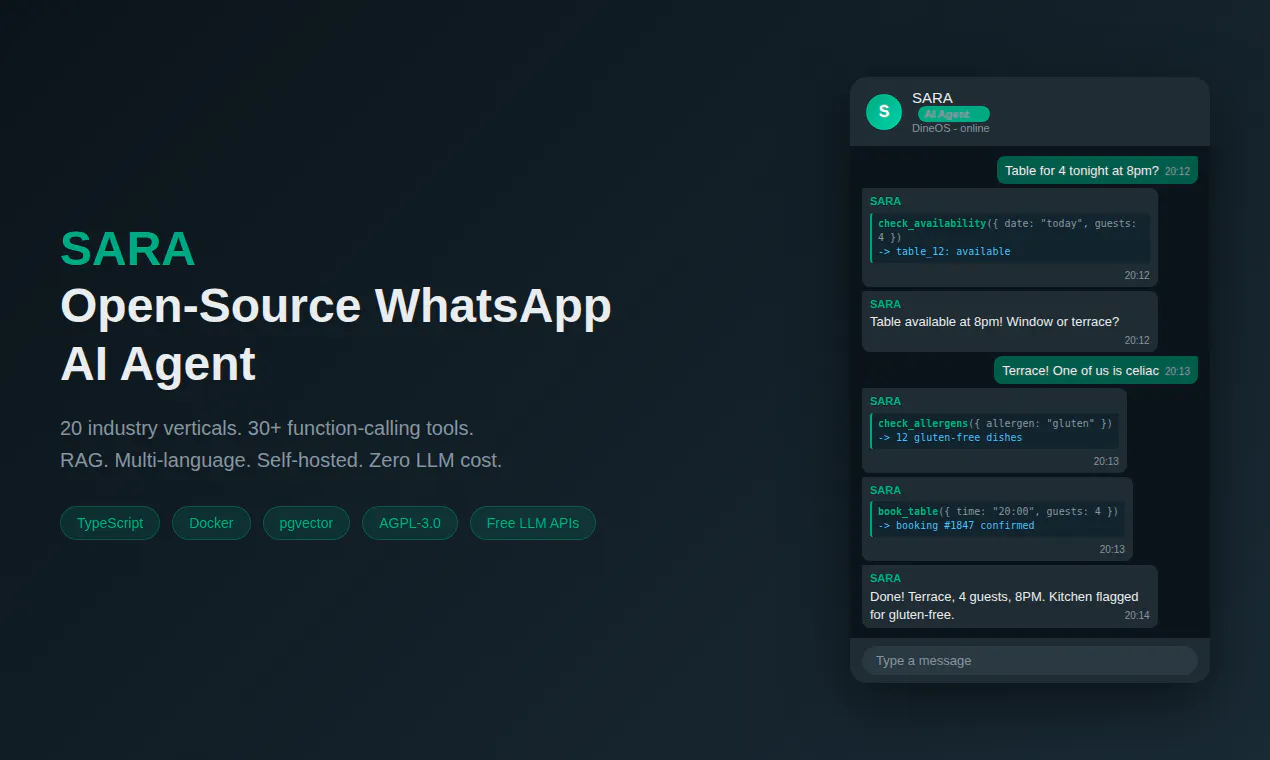
SARA
Open-source WhatsApp AI agent - 20 industry-specific brains
Detailed Feature Comparison Matrix
Compare Other Tools| Dimension | SARA |  BDFL - Benevolent Delegator for LLMs BDFL - Benevolent Delegator for LLMs |
|---|---|---|
| Primary Category | Open Source | Open Source |
| Community Rating | No ratings(0 reviews) | No ratings(0 reviews) |
| Community Upvotes | 7 votes | 6 votes |
| Supported Platforms | Web | Web |
| Tags & Focus | #GitHub#Artificial Intelligence#SaaS#Open Source | #Developer Tools#OpenAI Day#GitHub#Artificial Intelligence#Open Source |
| Maker / Company | Independent Developer | Independent Developer |
| Platform Verification | Community Listing | Community Listing |
About SARA
SARA is an open-source, self-hostable AI agent designed specifically for WhatsApp. Released under the AGPL-3.0 license by developer Alessandro Binda, SARA provides businesses with a customizable conversational assistant that operates natively on the WhatsApp platform.
Built to handle context-aware business interactions, SARA comes equipped with 20 industry-specific brains tailored for various verticals, including restaurants, medical clinics, real estate agencies, and beauty salons. The platform leverages advanced features like Retrieval-Augmented Generation (RAG), multi-language support, and function calling powered by over 30 integrated tools.
SARA is designed for easy deployment and cost-efficient scaling. It works out of the box with Docker Compose for local self-hosting or cloud deployment, and connects seamlessly with high-speed, free LLM inference providers such as Groq, Cerebras, and SambaNova.
Pros of SARA
- Open-source software licensed under AGPL-3.0
- Pre-packaged with 20 industry-specific brains (e.g., clinics, real estate, restaurants)
- Supports function calling with 30+ tools and RAG capabilities
- Integrates with free LLM inference providers like Groq, Cerebras, and SambaNova
- Simple deployment out of the box using Docker Compose
Cons of SARA
- Requires technical infrastructure setup for Docker self-hosting
- Deployment and management currently focused primarily on WhatsApp
Frequently Asked Questions
What is SARA?
SARA is an open-source, self-hostable AI agent designed for WhatsApp. It helps businesses automate communication using pre-configured industry-specific models and tools.
What industries does SARA support out of the box?
SARA includes 20 industry-specific brains tailored for verticals such as restaurants, healthcare clinics, real estate, and salons, among others.
How do I deploy SARA?
SARA can be self-hosted using Docker Compose out of the box, or configured to run in the cloud.
Which LLM providers work with SARA?
SARA supports free LLM inference providers including Groq, Cerebras, and SambaNova.
What key AI features does SARA offer?
SARA offers Retrieval-Augmented Generation (RAG), function calling with 30+ built-in tools, multi-language support, and industry-tailored prompt architectures.
About BDFL - Benevolent Delegator for LLMs
BDFL (Benevolent Delegator for LLMs) is an open-source terminal supervisor designed to orchestrate complex coding sessions using AI agents like Codex, Claude Code, and Ollama. Instead of relying on a single AI window, BDFL separates the workflow into specialized roles. Users interact with a 'planning agent' to create versioned, deliberate plans. Once the human user approves the plan—or specific sections of it—BDFL automatically delegates the tasks to isolated 'worker agents' that execute the code in parallel. Beyond just task delegation, the platform handles the heavy lifting of scheduling, running checks, verifying code, and managing integration. Every worker operates in an isolated environment, ensuring that code changes are properly sandboxed and reviewed before being merged. Because it operates entirely locally without any telemetry or centralized tracking, BDFL offers developers a secure, deterministic, and highly observable way to scale their AI-assisted software development.
Pros of BDFL - Benevolent Delegator for LLMs
- Orchestrates multiple AI agents (Codex, Claude Code, Ollama) and allows parallel execution of tasks within isolated worktrees.
- Supports deliberate planning with versioned plans and individual section approvals to ensure tight human oversight.
- Operates entirely locally with no telemetry, keeping runtime state, plans, and source code completely private.
Cons of BDFL - Benevolent Delegator for LLMs
- Currently limited to macOS and Linux environments, with Windows support only listed as planned.
- Requires a highly technical setup, including Node.js 20+, Git, and comfort with advanced CLI workflows.
Frequently Asked Questions
What AI models and agents does BDFL support?
BDFL supports Codex, Claude Code, and local open-source models via Ollama. You can even mix and match models, using one for the planning role and another for the execution workers.
Is my code or data sent to a centralized BDFL server?
No. BDFL operates completely locally and does not collect or publish telemetry, analytics, or runtime state. If you use Ollama with a local model, your entire workflow remains entirely on your machine.