
ProxAI vs GTA DataCity
Comprehensive feature analysis, ratings breakdown, platform compatibility, and community review comparison.
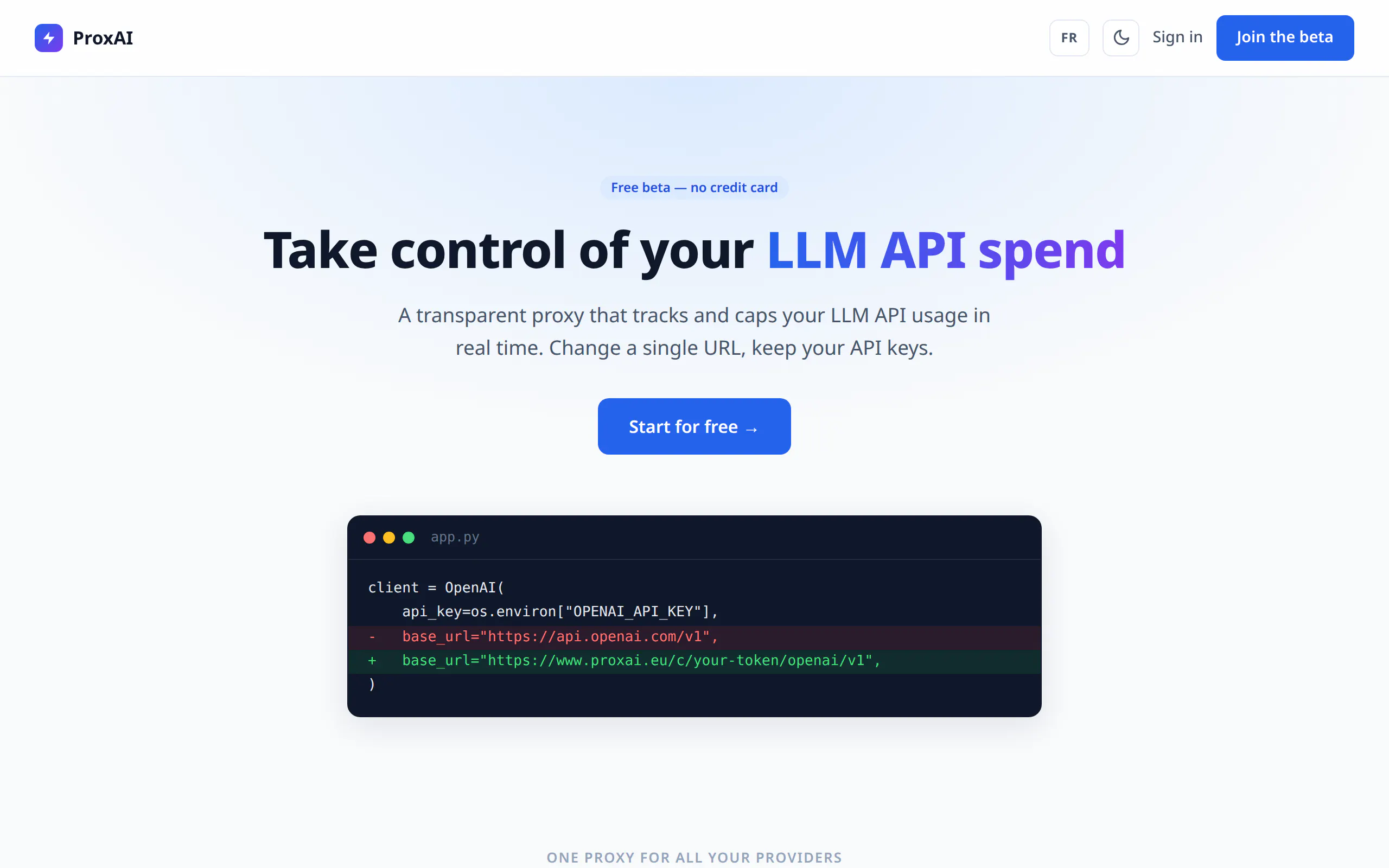
ProxAI
Hard budget caps for LLM APIs — one base_url change
Detailed Feature Comparison Matrix
Compare Other Tools| Dimension | ProxAI |  GTA DataCity |
|---|---|---|
| Primary Category | Open Source | Open Source |
| Community Rating | No ratings(0 reviews) | No ratings(0 reviews) |
| Community Upvotes | 6 votes | 84 votes |
| Supported Platforms | Web | Web |
| Tags & Focus | #Artificial Intelligence#Developer Tools#Open Source#GitHub | #Open Source#Maps#Games#OpenAI Day |
| Maker / Company | Independent Developer | Independent Developer |
| Platform Verification | Community Listing | Community Listing |
About ProxAI
ProxAI is a transparent reverse proxy designed to enforce hard hourly and daily spending caps per LLM API client. With a simple change of just one base_url and no SDK required, developers can seamlessly protect their budgets against runaway LLM costs.
The tool works out-of-the-box with major providers including OpenAI, Anthropic, Mistral, Groq, DeepSeek, and 5 others. If a client goes over its set cap, ProxAI immediately responds with a 429 status code before the upstream provider is ever called, ensuring that the worst-case scenario is your predefined cap rather than an unexpected credit card bill.
ProxAI is fully open-source (licensed under AGPL-3.0) and highly portable. It can be self-hosted as a single Go binary or a lightweight ~10 MB Docker image supporting both amd64 and arm64 architectures with zero telemetry. Alternatively, users can take advantage of the hosted beta version available at proxai.eu, which is free and requires no credit card.
Pros of ProxAI
- Enforces hard hourly and daily spending caps per LLM API client
- Requires only a single base_url change with no SDK needed
- Supports OpenAI, Anthropic, Mistral, Groq, DeepSeek, and 5 additional providers
- Blocks requests exceeding the cap (returning 429) before calling upstream
- Highly self-hostable as a single Go binary or lightweight ~10 MB Docker image with zero telemetry
Cons of ProxAI
- Hosted version is currently in beta
- Open-source license is AGPL-3.0, which may have specific compliance requirements for commercial adaptations
- Limited to the specific providers and features outlined in the current tool scope
Frequently Asked Questions
How does ProxAI enforce spending caps?
ProxAI acts as a transparent reverse proxy. When a client makes a request, it checks the hourly or daily spending limits. If the cap is exceeded, it immediately returns a 429 status code before the upstream API is ever called.
Do I need to install a special SDK to use ProxAI?
No SDK is required. You only need to change a single base_url in your existing configuration to route your requests through ProxAI.
Which LLM providers are supported?
ProxAI supports OpenAI, Anthropic, Mistral, Groq, DeepSeek, and 5 additional providers.
Can I self-host ProxAI?
Yes, ProxAI is fully self-hostable. It is available as a single Go binary or a lightweight ~10 MB Docker image (supporting amd64 and arm64) with zero telemetry, licensed under AGPL-3.0.
About GTA DataCity
GTA DataCity is a unique open-source application that turns geographic data into an interactive game experience. Described as a tiny 3D platformer atlas, the tool visualizes a curated dataset of San Francisco's AI coworking spaces.
Developed by Jas (Cassini Research), GTA DataCity provides a playful, gamified approach to mapping and exploring tech hubs. Hosted on Vercel and backed by an open-source GitHub repository, it offers a novel way to navigate datasets using 3D platformer mechanics instead of traditional static maps.
Pros of GTA DataCity
- Gamifies data visualization using a 3D platformer concept
- Open-source project with code accessible on GitHub
- Easily accessible directly in the browser via Vercel
- Creative mapping approach for San Francisco's AI coworking ecosystem
Cons of GTA DataCity
- Highly niche dataset limited to San Francisco AI coworking spaces
- Simple platformer scope rather than a complex gaming experience
Frequently Asked Questions
What is GTA DataCity?
GTA DataCity is an open-source web application that visualizes a dataset of San Francisco's AI coworking spaces as a tiny 3D platformer game.
Is GTA DataCity open source?
Yes, GTA DataCity is an open-source project and provides links to its source code on GitHub.
Where is GTA DataCity hosted?
GTA DataCity is hosted on Vercel and can be accessed directly through a web browser.
Who created GTA DataCity?
GTA DataCity was created by Jas from Cassini Research.