
ProxAI vs Caw
Comprehensive feature analysis, ratings breakdown, platform compatibility, and community review comparison.
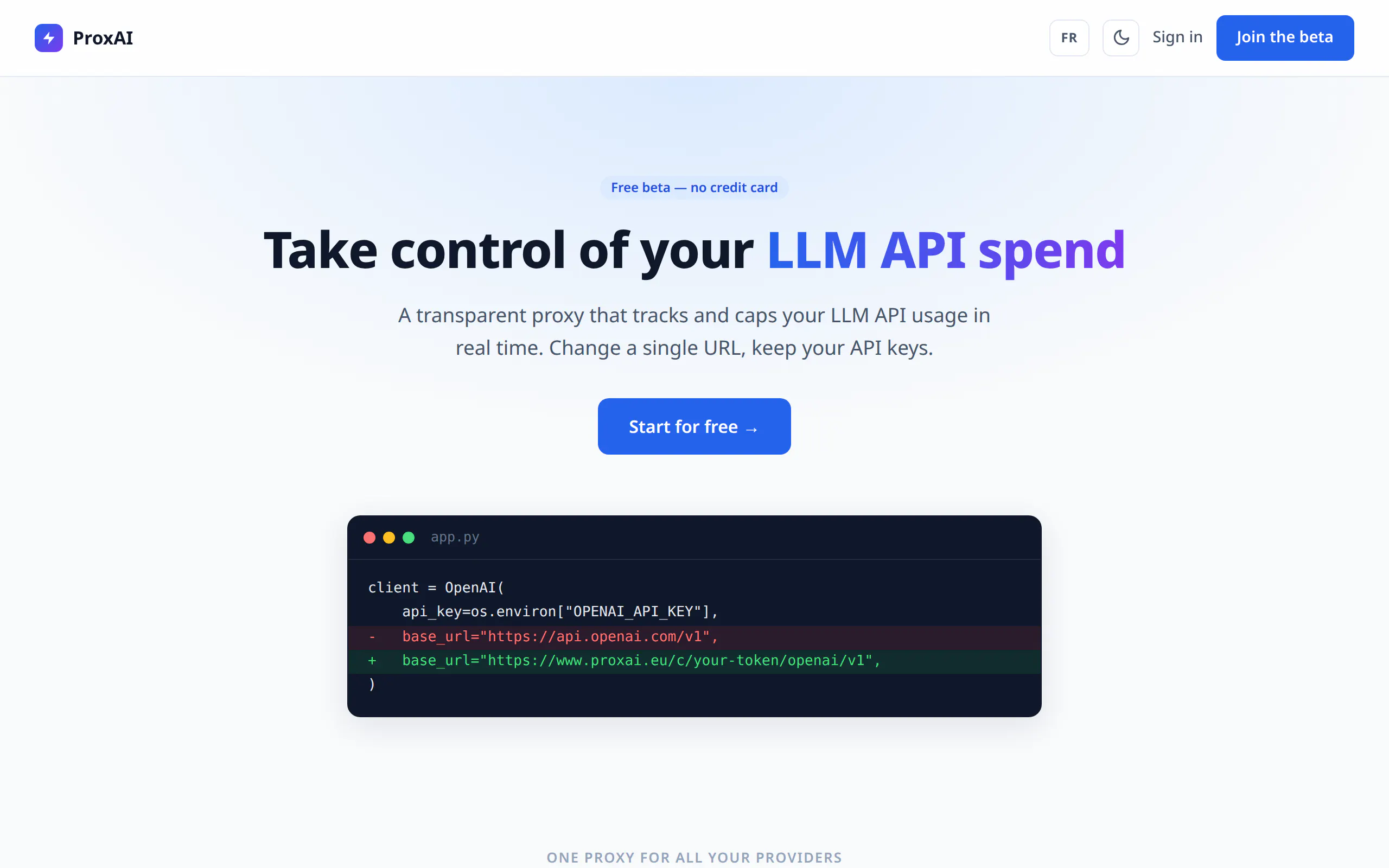
ProxAI
Hard budget caps for LLM APIs — one base_url change
Detailed Feature Comparison Matrix
Compare Other Tools| Dimension | ProxAI |  Caw |
|---|---|---|
| Primary Category | Open Source | Open Source |
| Community Rating | No ratings(0 reviews) | No ratings(0 reviews) |
| Community Upvotes | 6 votes | 81 votes |
| Supported Platforms | Web | Web |
| Tags & Focus | #Developer Tools#GitHub#Artificial Intelligence#Open Source | #Developer Tools#OpenAI Day#GitHub#Vibe coding#Open Source |
| Maker / Company | Independent Developer | Independent Developer |
| Platform Verification | Community Listing | Community Listing |
About ProxAI
ProxAI is a transparent reverse proxy designed to enforce hard hourly and daily spending caps per LLM API client. With a simple change of just one base_url and no SDK required, developers can seamlessly protect their budgets against runaway LLM costs.
The tool works out-of-the-box with major providers including OpenAI, Anthropic, Mistral, Groq, DeepSeek, and 5 others. If a client goes over its set cap, ProxAI immediately responds with a 429 status code before the upstream provider is ever called, ensuring that the worst-case scenario is your predefined cap rather than an unexpected credit card bill.
ProxAI is fully open-source (licensed under AGPL-3.0) and highly portable. It can be self-hosted as a single Go binary or a lightweight ~10 MB Docker image supporting both amd64 and arm64 architectures with zero telemetry. Alternatively, users can take advantage of the hosted beta version available at proxai.eu, which is free and requires no credit card.
Pros of ProxAI
- Enforces hard hourly and daily spending caps per LLM API client
- Requires only a single base_url change with no SDK needed
- Supports OpenAI, Anthropic, Mistral, Groq, DeepSeek, and 5 additional providers
- Blocks requests exceeding the cap (returning 429) before calling upstream
- Highly self-hostable as a single Go binary or lightweight ~10 MB Docker image with zero telemetry
Cons of ProxAI
- Hosted version is currently in beta
- Open-source license is AGPL-3.0, which may have specific compliance requirements for commercial adaptations
- Limited to the specific providers and features outlined in the current tool scope
Frequently Asked Questions
How does ProxAI enforce spending caps?
ProxAI acts as a transparent reverse proxy. When a client makes a request, it checks the hourly or daily spending limits. If the cap is exceeded, it immediately returns a 429 status code before the upstream API is ever called.
Do I need to install a special SDK to use ProxAI?
No SDK is required. You only need to change a single base_url in your existing configuration to route your requests through ProxAI.
Which LLM providers are supported?
ProxAI supports OpenAI, Anthropic, Mistral, Groq, DeepSeek, and 5 additional providers.
Can I self-host ProxAI?
Yes, ProxAI is fully self-hostable. It is available as a single Go binary or a lightweight ~10 MB Docker image (supporting amd64 and arm64) with zero telemetry, licensed under AGPL-3.0.
About Caw
Caw is an open-source web terminal multiplexer specifically designed for managing and interacting with AI coding agents. Whether you are using OpenCode, Claude Code, Codex, Copilot, Antigravity, or Pi, Caw streamlines your workflow by allowing you to monitor multiple agent sessions from anywhere, with specialized optimization for mobile devices.
Beyond its robust terminal multiplexer capabilities, Caw comes equipped with a suite of developer-focused features designed to supercharge your 'vibe coding' experience. It includes a built-in file browser and editor, a Kanban-like board that gives you a clear overview of all currently running agents, and instant push notifications to alert you whenever an agent completes a task or requires your input.
To help developers scale their productivity, Caw also supports on-demand Git worktrees for parallelizing work, as well as an innovative voice mode for hands-free interaction. Built for developers who rely on modern AI tooling, Caw brings transparency, mobility, and control to autonomous agent management.
Pros of Caw
- Open-source and designed specifically for AI agent workflows
- Monitor and control multiple agent sessions from anywhere, especially optimized for mobile
- Includes push notifications for task completions and input requests
- Features a built-in file browser, editor, and Kanban-like board for agent management
- Supports on-demand Git worktrees and voice mode for enhanced productivity
Cons of Caw
- Requires familiarity with AI coding agents like Claude Code, Codex, and Copilot
- Setup and management depend on external AI tools and terminal environments
- Mobile monitoring requires active connection and notification configurations
Frequently Asked Questions
What is Caw?
Caw is an open-source web terminal multiplexer built specifically for monitoring and interacting with multiple AI agent sessions, such as Claude Code, Codex, Copilot, OpenCode, Antigravity, and Pi.
Which AI agents are supported by Caw?
Caw supports popular AI coding agents including OpenCode, Claude Code, Codex, Copilot, Antigravity, and Pi.
What key features does Caw include?
In addition to the web terminal multiplexer, Caw includes a built-in file browser and editor, a Kanban-like agent overview board, push notifications for agent updates, on-demand Git worktrees, and a voice mode.
Can I use Caw on mobile devices?
Yes, Caw makes it easy to monitor and interact with your agent sessions from anywhere, with a design tailored to work well on mobile devices.