
ProxAI vs Aming Claw
Comprehensive feature analysis, ratings breakdown, platform compatibility, and community review comparison.
ProxAI
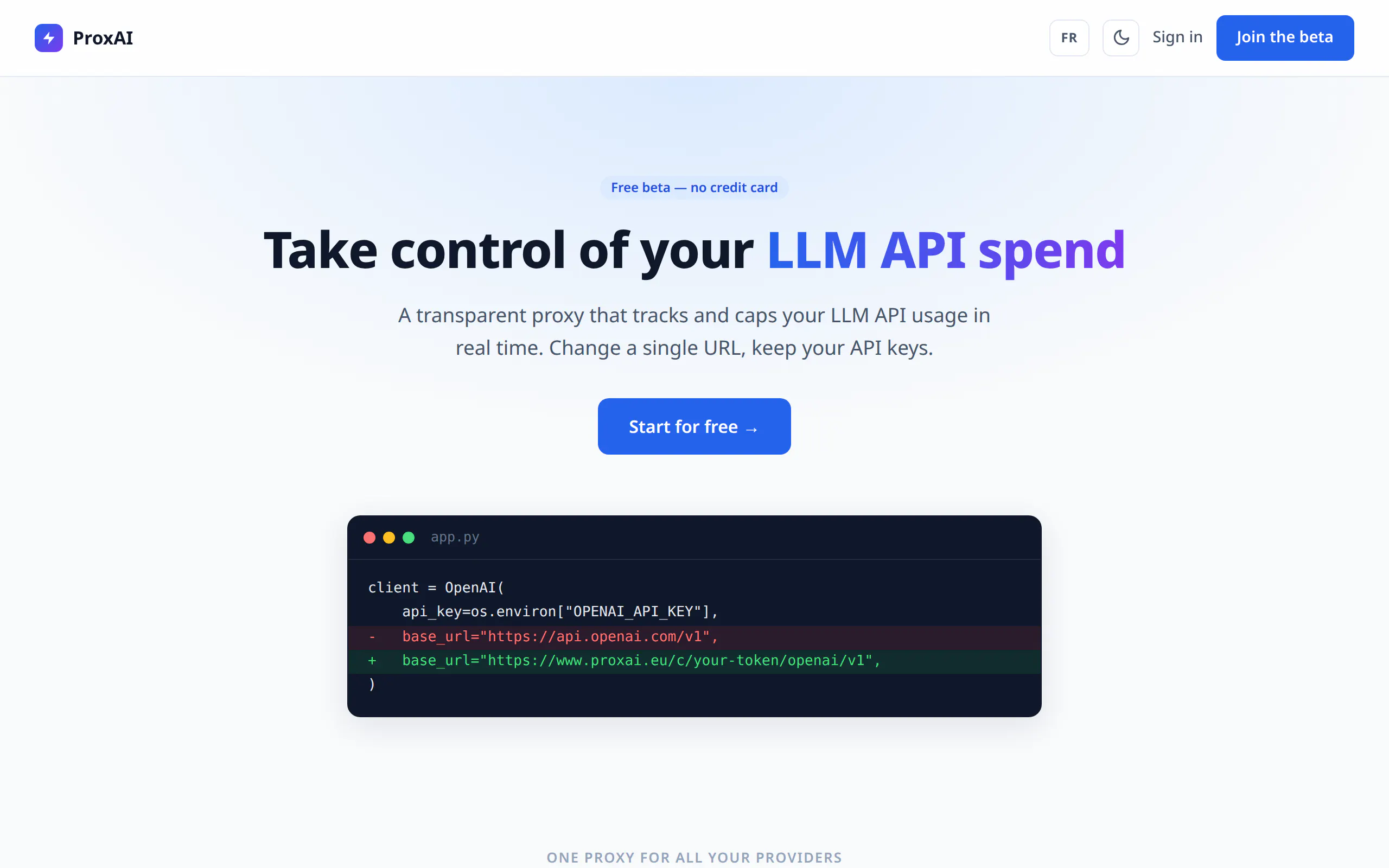
Hard budget caps for LLM APIs — one base_url change
Detailed Feature Comparison Matrix
Compare Other Tools| Dimension | ProxAI |  Aming Claw |
|---|---|---|
| Primary Category | Open Source | Open Source |
| Community Rating | No ratings(0 reviews) | No ratings(0 reviews) |
| Community Upvotes | 6 votes | 5 votes |
| Supported Platforms | Web | Web |
| Tags & Focus | #Artificial Intelligence#Developer Tools#Open Source#GitHub | #Developer Tools#Open Source#OpenAI Day |
| Maker / Company | Independent Developer | Independent Developer |
| Platform Verification | Community Listing | Community Listing |
About ProxAI
ProxAI is a transparent reverse proxy designed to enforce hard hourly and daily spending caps per LLM API client. With a simple change of just one base_url and no SDK required, developers can seamlessly protect their budgets against runaway LLM costs.
The tool works out-of-the-box with major providers including OpenAI, Anthropic, Mistral, Groq, DeepSeek, and 5 others. If a client goes over its set cap, ProxAI immediately responds with a 429 status code before the upstream provider is ever called, ensuring that the worst-case scenario is your predefined cap rather than an unexpected credit card bill.
ProxAI is fully open-source (licensed under AGPL-3.0) and highly portable. It can be self-hosted as a single Go binary or a lightweight ~10 MB Docker image supporting both amd64 and arm64 architectures with zero telemetry. Alternatively, users can take advantage of the hosted beta version available at proxai.eu, which is free and requires no credit card.
Pros of ProxAI
- Enforces hard hourly and daily spending caps per LLM API client
- Requires only a single base_url change with no SDK needed
- Supports OpenAI, Anthropic, Mistral, Groq, DeepSeek, and 5 additional providers
- Blocks requests exceeding the cap (returning 429) before calling upstream
- Highly self-hostable as a single Go binary or lightweight ~10 MB Docker image with zero telemetry
Cons of ProxAI
- Hosted version is currently in beta
- Open-source license is AGPL-3.0, which may have specific compliance requirements for commercial adaptations
- Limited to the specific providers and features outlined in the current tool scope
Frequently Asked Questions
How does ProxAI enforce spending caps?
ProxAI acts as a transparent reverse proxy. When a client makes a request, it checks the hourly or daily spending limits. If the cap is exceeded, it immediately returns a 429 status code before the upstream API is ever called.
Do I need to install a special SDK to use ProxAI?
No SDK is required. You only need to change a single base_url in your existing configuration to route your requests through ProxAI.
Which LLM providers are supported?
ProxAI supports OpenAI, Anthropic, Mistral, Groq, DeepSeek, and 5 additional providers.
Can I self-host ProxAI?
Yes, ProxAI is fully self-hostable. It is available as a single Go binary or a lightweight ~10 MB Docker image (supporting amd64 and arm64) with zero telemetry, licensed under AGPL-3.0.
About Aming Claw
Aming Claw is an open-source governance infrastructure designed specifically to solve the problem of AI agent drift during long-running work. When autonomous agents lose their verified state and begin guessing among multiple potential next actions, reliability plummets. Aming Claw addresses this by verifying an agent’s exact position, pushing a single legal next entrance, and strictly preserving causal evidence across handoffs.
Built as a robust developer tool, Aming Claw introduces a graph-backed backlog, independent worker and QA roles, auditable bypasses, and controlled merge/reconcile flows. The core philosophy is to shift human intervention from acting as an expensive, real-time GPS to providing high-level judgment only when truly needed.
Pros of Aming Claw
- Prevents AI agent drift during long-running tasks by verifying state and enforcing single legal next steps
- Open-source infrastructure with graph-backed backlogs and causal evidence preservation across handoffs
- Separates concerns with independent worker and QA roles
- Includes controlled merge/reconcile flows and auditable bypasses
Cons of Aming Claw
- Requires setup and integration as a developer tool
- Relies on community/open-source support channels via GitHub and Twitter
Frequently Asked Questions
What is Aming Claw?
Aming Claw is open-source governance infrastructure built to ensure reliable, long-running AI agents by verifying their position, enforcing legal next actions, and preserving causal evidence.
How does Aming Claw prevent AI agent drift?
It prevents drift by verifying the agent's current state, pushing one legal next entrance, utilizing a graph-backed backlog, and enforcing independent worker/QA roles with controlled merge and reconcile flows.
Where can I access Aming Claw?
Aming Claw is available as an open-source project on GitHub via the official repository links.