
ProxAI vs AI Eyes
Comprehensive feature analysis, ratings breakdown, platform compatibility, and community review comparison.
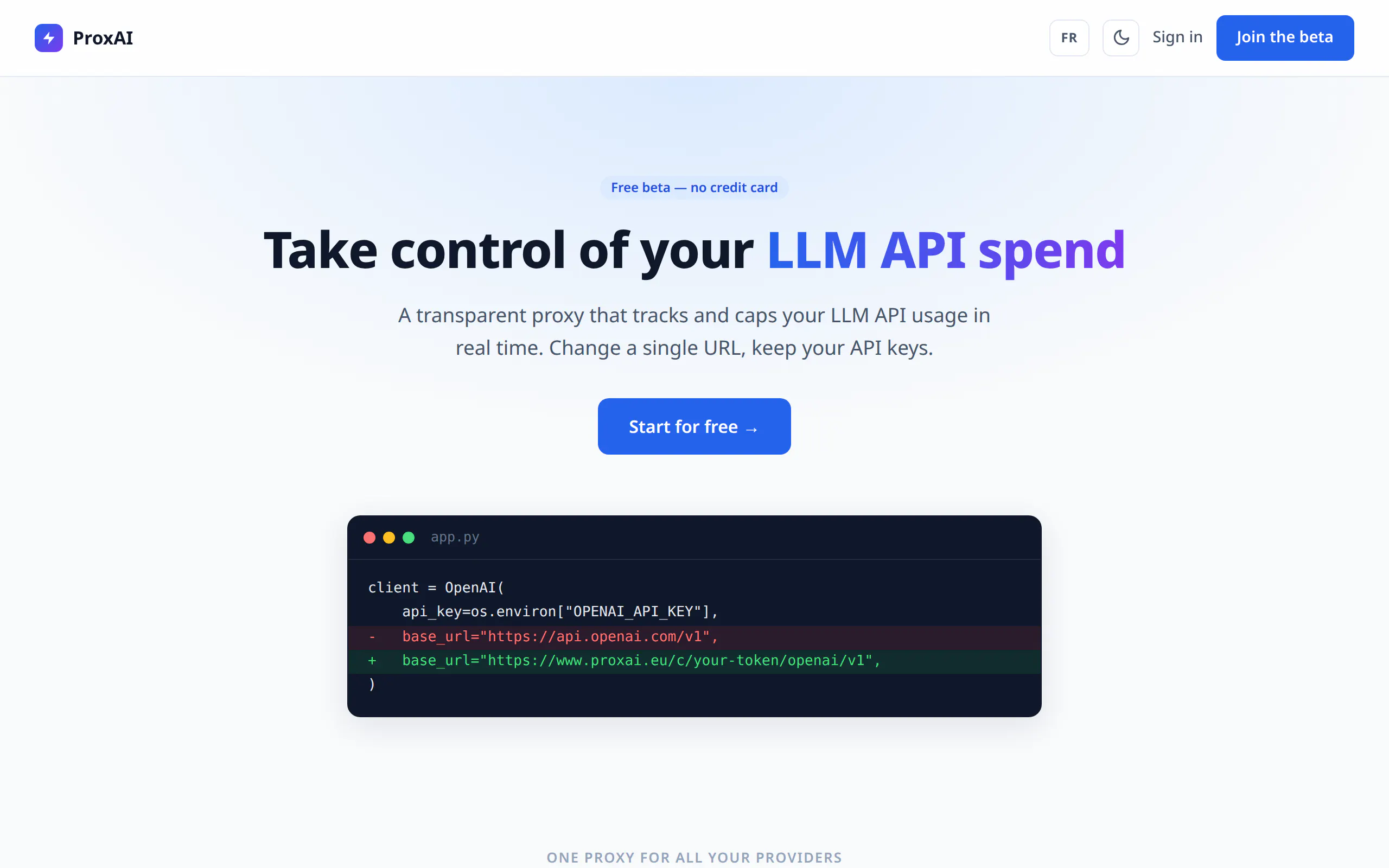
ProxAI
Hard budget caps for LLM APIs — one base_url change
Detailed Feature Comparison Matrix
Compare Other Tools| Dimension | ProxAI |  AI Eyes |
|---|---|---|
| Primary Category | Open Source | Open Source |
| Community Rating | No ratings(0 reviews) | No ratings(0 reviews) |
| Community Upvotes | 6 votes | 63 votes |
| Supported Platforms | Web | Web |
| Tags & Focus | #Artificial Intelligence#Developer Tools#Open Source#GitHub | #Developer Tools#Open Source#Privacy#OpenAI Day |
| Maker / Company | Independent Developer | Independent Developer |
| Platform Verification | Community Listing | Community Listing |
About ProxAI
ProxAI is a transparent reverse proxy designed to enforce hard hourly and daily spending caps per LLM API client. With a simple change of just one base_url and no SDK required, developers can seamlessly protect their budgets against runaway LLM costs.
The tool works out-of-the-box with major providers including OpenAI, Anthropic, Mistral, Groq, DeepSeek, and 5 others. If a client goes over its set cap, ProxAI immediately responds with a 429 status code before the upstream provider is ever called, ensuring that the worst-case scenario is your predefined cap rather than an unexpected credit card bill.
ProxAI is fully open-source (licensed under AGPL-3.0) and highly portable. It can be self-hosted as a single Go binary or a lightweight ~10 MB Docker image supporting both amd64 and arm64 architectures with zero telemetry. Alternatively, users can take advantage of the hosted beta version available at proxai.eu, which is free and requires no credit card.
Pros of ProxAI
- Enforces hard hourly and daily spending caps per LLM API client
- Requires only a single base_url change with no SDK needed
- Supports OpenAI, Anthropic, Mistral, Groq, DeepSeek, and 5 additional providers
- Blocks requests exceeding the cap (returning 429) before calling upstream
- Highly self-hostable as a single Go binary or lightweight ~10 MB Docker image with zero telemetry
Cons of ProxAI
- Hosted version is currently in beta
- Open-source license is AGPL-3.0, which may have specific compliance requirements for commercial adaptations
- Limited to the specific providers and features outlined in the current tool scope
Frequently Asked Questions
How does ProxAI enforce spending caps?
ProxAI acts as a transparent reverse proxy. When a client makes a request, it checks the hourly or daily spending limits. If the cap is exceeded, it immediately returns a 429 status code before the upstream API is ever called.
Do I need to install a special SDK to use ProxAI?
No SDK is required. You only need to change a single base_url in your existing configuration to route your requests through ProxAI.
Which LLM providers are supported?
ProxAI supports OpenAI, Anthropic, Mistral, Groq, DeepSeek, and 5 additional providers.
Can I self-host ProxAI?
Yes, ProxAI is fully self-hostable. It is available as a single Go binary or a lightweight ~10 MB Docker image (supporting amd64 and arm64) with zero telemetry, licensed under AGPL-3.0.
About AI Eyes
AI Eyes is a permission-first co-presence prototype designed for AI companions. Created by developer Deen Storkey, this open-source tool establishes a privacy-focused, local-first foundation for managing what your digital companions can see and hear.
With its initial v0.1 release, AI Eyes allows users to choose a specific screen or window to capture and gives granular, separate controls for screen, system audio, and microphone inputs. The interface makes it easy to invite named companions and ensures transparency by always displaying when sensing is active. Users can pause or end sessions at any time; ending a session immediately stops all media tracks and resets the session completely.
Built using Codex and GPT-5.6, this prototype is focused entirely on local-first permission, presence, and session-control. Please note that in this foundational stage, no external AI provider or semantic understanding has been connected yet.
Pros of AI Eyes
- Privacy-focused, local-first permission architecture
- Separate, granular control over screen, system audio, and microphone capture
- Clear visual indicators showing when active sensing is occurring
- Open-source code base allowing developers to review and build upon the prototype
Cons of AI Eyes
- It is a prototype (v0.1) and does not yet have an active AI provider or semantic understanding connected
- Limited to foundational capture and session-control features at this stage
Frequently Asked Questions
What is AI Eyes?
AI Eyes is an open-source, permission-first co-presence prototype built to manage what AI companions can access. It provides local-first controls over screen sharing, audio, and session state.
Does AI Eyes currently analyze my screen or voice?
No. In the v0.1 release, no AI provider or semantic understanding is connected. The prototype is currently a local-first foundation focused on permission, capture, presence, and session-control.
How do I control my privacy while using AI Eyes?
AI Eyes lets you choose exactly which screen or window to capture and gives you separate toggle controls for your screen, system audio, and microphone. There is also a clear indicator to show when sensing is active, and you can pause or end the session to stop all media tracks instantly.
What technologies were used to build AI Eyes?
The AI Eyes prototype was built using Codex and GPT-5.6.