
Model Boss vs Skeg
Comprehensive feature analysis, ratings breakdown, platform compatibility, and community review comparison.
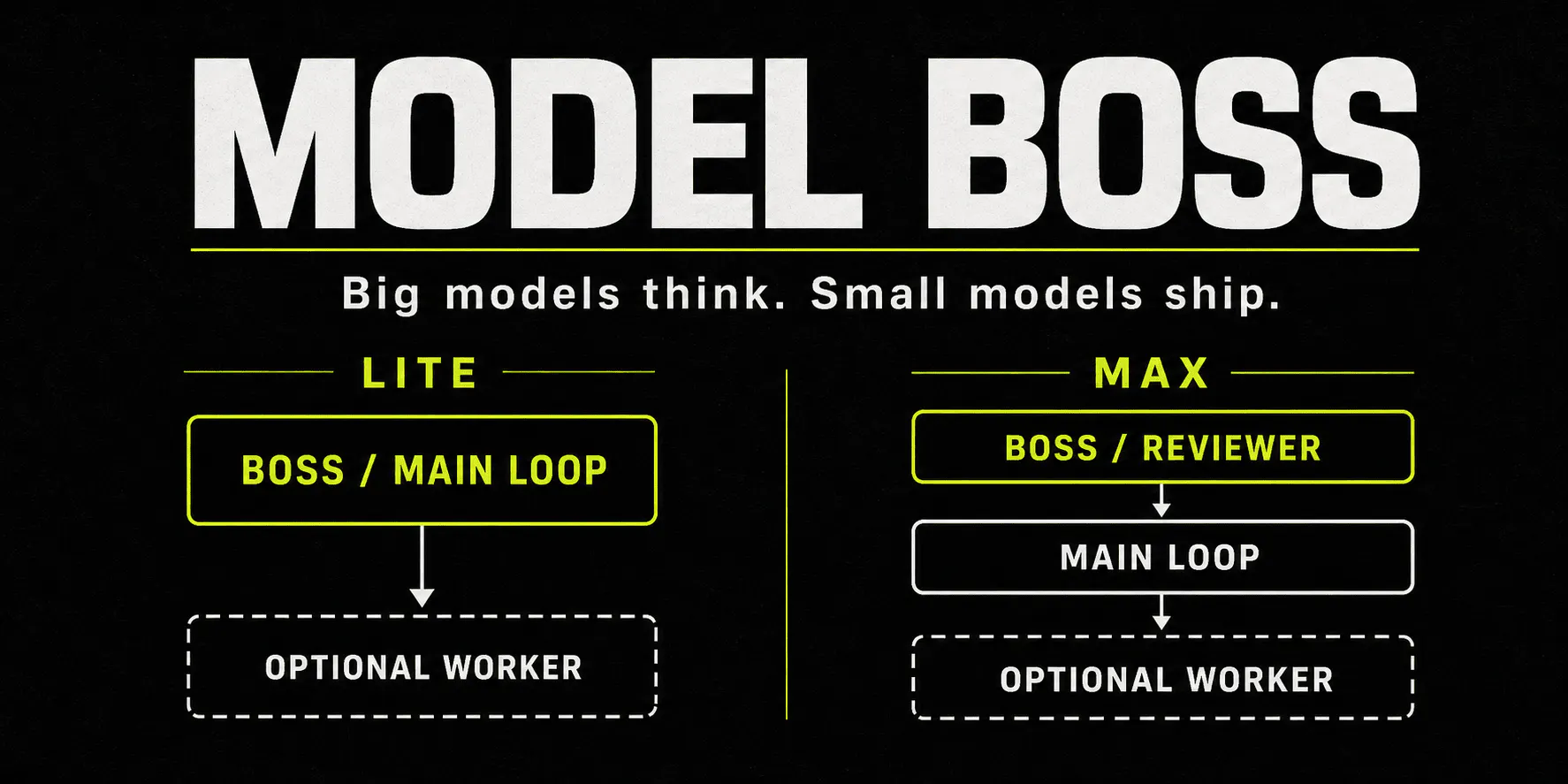
Model Boss
Delegate code to cheaper models. Keep frontier judgment.
Detailed Feature Comparison Matrix
Compare Other Tools| Dimension | Model Boss |  Skeg |
|---|---|---|
| Primary Category | Developer Tools | Developer Tools |
| Community Rating | No ratings(0 reviews) | No ratings(0 reviews) |
| Community Upvotes | 6 votes | 6 votes |
| Supported Platforms | Web | Web |
| Tags & Focus | #Artificial Intelligence#Developer Tools#GitHub | #Artificial Intelligence#Developer Tools#Database |
| Maker / Company | Independent Developer | Independent Developer |
| Platform Verification | Community Listing | Community Listing |
About Model Boss
Model Boss is an AI orchestrator designed to optimize developer workflows by strategically delegating coding tasks across multiple artificial intelligence models. Created by Vince, the tool aims to significantly reduce API costs without sacrificing output quality by enforcing a clear separation of labor between frontier and lower-cost models.
With Model Boss, bounded code implementation tasks are routed to lower-cost worker models. Meanwhile, a stronger, frontier AI model maintains oversight—approving initial execution plans and reviewing final evidence before code is finalized. To ensure security and code integrity, all tasks run within disposable worktrees featuring OS sandboxing, enforced tool limits, hash-bound approvals, and strict test gates.
Pros of Model Boss
- Cost-effective workflow that delegates heavy implementation tasks to cheaper models
- Maintains high code quality using frontier models for plan approvals and final verification
- Secure execution environment using disposable worktrees and OS sandboxing
- Built-in quality controls including test gates, tool limits, and hash-bound approvals
Cons of Model Boss
- Requires orchestration across multiple models and developer tools
- Multi-step approval process may add pipeline latency compared to single-model execution
Frequently Asked Questions
What is Model Boss?
Model Boss is a developer tool that orchestrates Claude Code and Codex across multiple models. It delegates bounded coding tasks to lower-cost worker models while reserving frontier models for approving plans and verifying final code.
How does Model Boss reduce AI coding costs?
Model Boss lowers costs by routing repetitive or bounded implementation work to cheaper AI models, while only using higher-cost frontier models for high-level decision-making, plan approvals, and final checks.
What security measures does Model Boss use?
Model Boss executes work inside disposable worktrees using OS sandboxing, tool limits, test gates, and hash-bound approvals to prevent unauthorized system modifications and broken code.
About Skeg
Skeg is an open-source, multi-tenant vector database written in Rust, designed specifically to address memory constraints in vector storage. It is engineered for extreme RAM efficiency, allowing developers to pack significantly more vectors per gigabyte of memory without sacrificing search recall.
Purpose-built for high-density, many-tenant deployments, Skeg treats memory efficiency as a primary design consideration rather than an afterthought. This makes it an ideal database solution for infrastructure setups where RAM capacity is the critical bottleneck.
Pros of Skeg
- Extreme RAM efficiency to pack more vectors per GB
- Maintains high search recall
- Specifically optimized for high-density, multi-tenant deployments
- Open source and written in Rust for performance and safety
Cons of Skeg
- Focused primarily on memory-constrained vector use cases, which may be redundant for environments with abundant RAM
- No managed cloud hosting or commercial support options are mentioned in the metadata
Frequently Asked Questions
What is Skeg?
Skeg is an open-source, multi-tenant vector database written in Rust. It is designed to offer extreme RAM efficiency, allowing you to store more vectors per GB while maintaining high recall.
Who is Skeg built for?
Skeg is purpose-built for high-density, many-tenant deployments where server memory (RAM) is the primary constraint or bottleneck.
Is Skeg open source?
Yes, Skeg is open-source software and its repository is hosted on GitHub.