
MCP-Billing vs NotifyBridge
Comprehensive feature analysis, ratings breakdown, platform compatibility, and community review comparison.
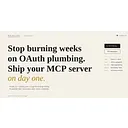
MCP-Billing
OAuth 2.1 + usage-based Stripe billing for MCP servers
Detailed Feature Comparison Matrix
Compare Other Tools| Dimension | MCP-Billing |  NotifyBridge |
|---|---|---|
| Primary Category | API | API |
| Community Rating | No ratings(0 reviews) | No ratings(0 reviews) |
| Community Upvotes | 117 votes | 74 votes |
| Supported Platforms | Web | Web |
| Tags & Focus | #Developer Tools#SaaS#GitHub#API | #Developer Tools#API#Hardware#OpenAI Day |
| Maker / Company | Independent Developer | Independent Developer |
| Platform Verification | Community Listing | Community Listing |
About MCP-Billing
MCP-Billing is a comprehensive, self-hosted Next.js and TypeScript boilerplate designed specifically for Model Context Protocol (MCP) servers. Built by Marc Gil, it bridges the gap between AI infrastructure and monetization by providing robust, production-ready backend modules.
The platform delivers everything developers need to commercialize their MCP servers, featuring full OAuth 2.1 + PKCE authorization, secure API key management with zero-downtime rotation, usage-based Stripe billing, and Redis rate limiting. Comprising 7 modular units and backed by over 300 tests, it ensures reliability and scalability.
Unlike closed ecosystems or platforms that take a cut of your revenue, MCP-Billing operates on a simple one-time purchase model with no ongoing revenue share or platform lock-in. Furthermore, its underlying metering core is free and open-source on npm, making it a flexible, developer-first solution for API and AI infrastructure monetization.
Pros of MCP-Billing
- Full OAuth 2.1 + PKCE support for secure authentication
- Usage-based Stripe billing integration out-of-the-box
- API key management featuring zero-downtime rotation
- Includes Redis rate limiting and 300+ tests across 7 modules
- One-time purchase fee with no revenue share or platform lock-in
Cons of MCP-Billing
- Self-hosted setup requires technical configuration and infrastructure management
- Limited to Next.js and TypeScript stack environments as a boilerplate
- Requires separate configuration and accounts for Stripe integration
Frequently Asked Questions
What is MCP-Billing?
MCP-Billing is a self-hosted Next.js and TypeScript boilerplate that equips MCP servers with OAuth 2.1 + PKCE authentication, API key management, Redis rate limiting, and usage-based Stripe billing.
How much does MCP-Billing cost?
MCP-Billing is available for a one-time fee of €79 with no revenue share or platform lock-in. Additionally, the metering core is free and open source on npm.
What technologies are used to build MCP-Billing?
It is built as a Next.js and TypeScript boilerplate, incorporating Redis for rate limiting, OAuth 2.1 for authentication, and Stripe for usage-based billing.
About NotifyBridge
NotifyBridge is a lightweight, backend-focused solution designed specifically for makers, smart home hobbyists, and developers who want a straightforward way to send push notifications from their hardware projects. Created by software programmer Nicu Gherasim, NotifyBridge eliminates the friction typically associated with getting IoT projects to communicate with mobile devices.
Traditionally, setting up mobile alerts for hardware required wrestling with heavy mobile SDKs, configuring complex platform certificates, or navigating massive, complicated cloud dashboards. NotifyBridge cuts through this complexity by offering a lightweight REST API. With it, any hardware project running on platforms like ESP32, Arduino, or Raspberry Pi can simply drop a webhook to trigger instant mobile alerts, letting makers focus on building their projects rather than fighting with infrastructure.
Pros of NotifyBridge
- Extremely simple REST API designed for hardware projects
- Compatible with popular maker platforms like ESP32, Arduino, and Raspberry Pi
- Bypasses the need for heavy mobile SDKs or platform certificates
- Eliminates the complexity of managing massive cloud dashboards
Cons of NotifyBridge
- Focused primarily on basic push notifications rather than advanced telemetry
- Limited information regarding built-in analytics or complex message routing
- Relies on webhook integration which requires basic network setup on the hardware side
Frequently Asked Questions
What is NotifyBridge?
NotifyBridge is a lightweight backend built for makers, smart home hobbyists, and developers that allows hardware projects to trigger instant mobile push notifications via a simple REST API and webhooks.
What hardware platforms are supported?
NotifyBridge is designed to work with popular maker and IoT platforms including ESP32, Arduino, and Raspberry Pi.
Do I need to use heavy mobile SDKs?
No. One of the main benefits of NotifyBridge is that it bypasses the need to fight with heavy mobile SDKs, platform certificates, or massive cloud dashboards.