
HookLens vs TenTags API & AI generate
Comprehensive feature analysis, ratings breakdown, platform compatibility, and community review comparison.
Detailed Feature Comparison Matrix
Compare Other Tools| Dimension | 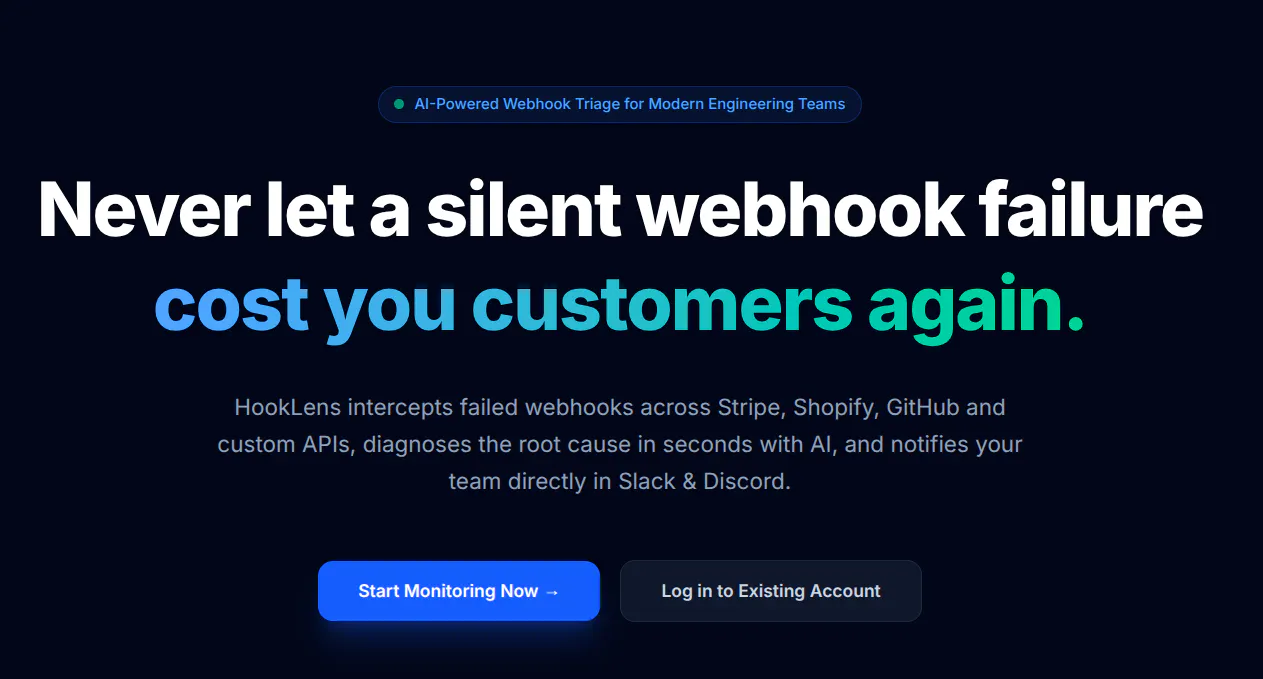 HookLens |  TenTags API & AI generate |
|---|---|---|
| Primary Category | API | API |
| Community Rating | No ratings(0 reviews) | No ratings(0 reviews) |
| Community Upvotes | 14 votes | 5 votes |
| Supported Platforms | Web | Web |
| Tags & Focus | #Developer Tools#SaaS#API | #Artificial Intelligence#Developer Tools#API |
| Maker / Company | Independent Developer | Independent Developer |
| Platform Verification | Community Listing | Community Listing |
About HookLens
HookLens is an AI-powered developer tool designed for real-time webhook triage and root-cause analysis. Created by Allan Pedersen, this tool helps software engineers and developers debug, monitor, and triage failed webhooks instantly.
By leveraging Gemini AI, HookLens takes the complexity out of webhook troubleshooting. It automatically translates cryptic JSON payloads and failure messages into clear, human-readable explanations of the root causes, complete with code-ready fixes to accelerate your development workflow.
Pros of HookLens
- Real-time monitoring and instant webhook triage
- Uses Gemini AI to explain cryptic JSON payloads clearly
- Provides code-ready fixes for faster error resolution
- Out-of-the-box support for Shopify and Stripe webhooks
Cons of HookLens
- Integrations are currently highlighted only for Stripe and Shopify in the provided metadata
- Relies on Gemini AI for generating root-cause analysis and fixes
Frequently Asked Questions
What is HookLens?
HookLens is a developer tool designed for real-time webhook monitoring, triage, and debugging. It helps teams quickly identify why webhooks fail and how to fix them.
Which integrations does HookLens support?
HookLens is built to monitor and triage webhooks specifically for Stripe and Shopify.
How does HookLens analyze webhook failures?
HookLens uses Gemini AI to analyze cryptic JSON payloads and webhook error details, translating them into clear, actionable root causes and code-ready fixes.
About TenTags API & AI generate
TenTags API & AI generate is an API-first document generation tool designed to streamline how developers and teams create structured files. By leveraging declarative Style/Data CSV templates, TenTags allows users to transform templates into HTML, PDF, XLSX, or DOCX files through a single authenticated endpoint.
Built for developer efficiency, the platform features a web playground where you can easily build and preview your templates before deploying them. Once ready, you can remotely generate documents from any backend system or via the command line interface (CLI), making it a flexible solution for modern software workflows.
Pros of TenTags API & AI generate
- API-first approach allows remote document generation from any backend or CLI
- Supports multiple popular output formats including HTML, PDF, XLSX, and DOCX
- Declarative Style/Data CSV templates simplify the document layout process
- Includes a web playground to build and preview templates in real time
Cons of TenTags API & AI generate
- Requires familiarity with API integrations and backend development
- Relies on declarative Style/Data CSV templates which may require a learning curve
- Limited documentation/details outside of core template-to-document conversion features
Frequently Asked Questions
What output formats does TenTags API support?
TenTags API supports generating documents in HTML, PDF, XLSX, and DOCX formats.
How do you create and test documents?
You can build and preview your declarative Style/Data CSV templates using the web playground, and then generate the final documents remotely from any backend or CLI via a single authenticated endpoint.
Who is this tool built for?
TenTags is designed primarily as a developer tool for software engineers and teams needing programmatic, API-driven document generation.