
HookLens vs NotifyBridge
Comprehensive feature analysis, ratings breakdown, platform compatibility, and community review comparison.
Detailed Feature Comparison Matrix
Compare Other Tools| Dimension | 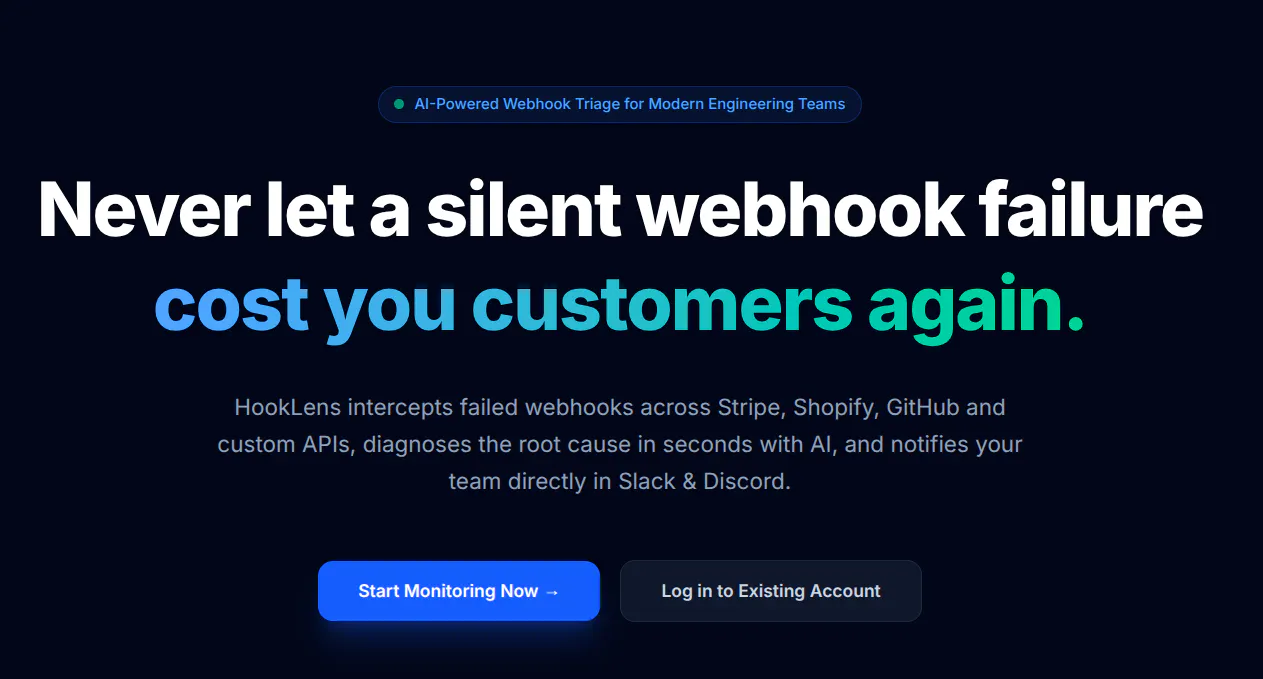 HookLens |  NotifyBridge |
|---|---|---|
| Primary Category | API | API |
| Community Rating | No ratings(0 reviews) | No ratings(0 reviews) |
| Community Upvotes | 14 votes | 74 votes |
| Supported Platforms | Web | Web |
| Tags & Focus | #Developer Tools#SaaS#API | #Developer Tools#API#Hardware#OpenAI Day |
| Maker / Company | Independent Developer | Independent Developer |
| Platform Verification | Community Listing | Community Listing |
About HookLens
HookLens is an AI-powered developer tool designed for real-time webhook triage and root-cause analysis. Created by Allan Pedersen, this tool helps software engineers and developers debug, monitor, and triage failed webhooks instantly.
By leveraging Gemini AI, HookLens takes the complexity out of webhook troubleshooting. It automatically translates cryptic JSON payloads and failure messages into clear, human-readable explanations of the root causes, complete with code-ready fixes to accelerate your development workflow.
Pros of HookLens
- Real-time monitoring and instant webhook triage
- Uses Gemini AI to explain cryptic JSON payloads clearly
- Provides code-ready fixes for faster error resolution
- Out-of-the-box support for Shopify and Stripe webhooks
Cons of HookLens
- Integrations are currently highlighted only for Stripe and Shopify in the provided metadata
- Relies on Gemini AI for generating root-cause analysis and fixes
Frequently Asked Questions
What is HookLens?
HookLens is a developer tool designed for real-time webhook monitoring, triage, and debugging. It helps teams quickly identify why webhooks fail and how to fix them.
Which integrations does HookLens support?
HookLens is built to monitor and triage webhooks specifically for Stripe and Shopify.
How does HookLens analyze webhook failures?
HookLens uses Gemini AI to analyze cryptic JSON payloads and webhook error details, translating them into clear, actionable root causes and code-ready fixes.
About NotifyBridge
NotifyBridge is a lightweight, backend-focused solution designed specifically for makers, smart home hobbyists, and developers who want a straightforward way to send push notifications from their hardware projects. Created by software programmer Nicu Gherasim, NotifyBridge eliminates the friction typically associated with getting IoT projects to communicate with mobile devices.
Traditionally, setting up mobile alerts for hardware required wrestling with heavy mobile SDKs, configuring complex platform certificates, or navigating massive, complicated cloud dashboards. NotifyBridge cuts through this complexity by offering a lightweight REST API. With it, any hardware project running on platforms like ESP32, Arduino, or Raspberry Pi can simply drop a webhook to trigger instant mobile alerts, letting makers focus on building their projects rather than fighting with infrastructure.
Pros of NotifyBridge
- Extremely simple REST API designed for hardware projects
- Compatible with popular maker platforms like ESP32, Arduino, and Raspberry Pi
- Bypasses the need for heavy mobile SDKs or platform certificates
- Eliminates the complexity of managing massive cloud dashboards
Cons of NotifyBridge
- Focused primarily on basic push notifications rather than advanced telemetry
- Limited information regarding built-in analytics or complex message routing
- Relies on webhook integration which requires basic network setup on the hardware side
Frequently Asked Questions
What is NotifyBridge?
NotifyBridge is a lightweight backend built for makers, smart home hobbyists, and developers that allows hardware projects to trigger instant mobile push notifications via a simple REST API and webhooks.
What hardware platforms are supported?
NotifyBridge is designed to work with popular maker and IoT platforms including ESP32, Arduino, and Raspberry Pi.
Do I need to use heavy mobile SDKs?
No. One of the main benefits of NotifyBridge is that it bypasses the need to fight with heavy mobile SDKs, platform certificates, or massive cloud dashboards.