
Ghostlink vs Rhetis
Comprehensive feature analysis, ratings breakdown, platform compatibility, and community review comparison.
Detailed Feature Comparison Matrix
Compare Other Tools| Dimension | 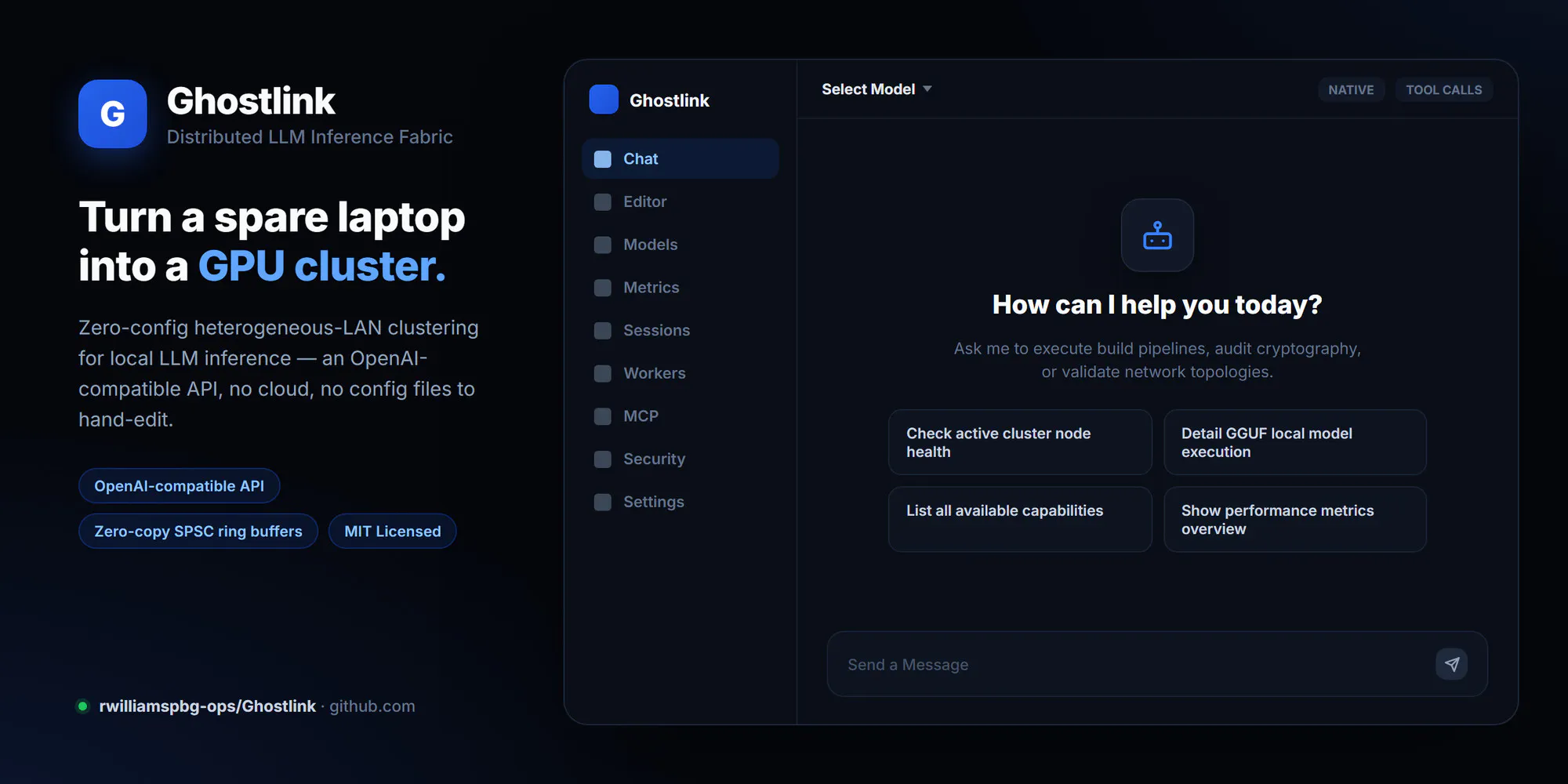 Ghostlink |  Rhetis |
|---|---|---|
| Primary Category | Design Tools | Design Tools |
| Community Rating | No ratings(0 reviews) | No ratings(0 reviews) |
| Community Upvotes | 11 votes | 8 votes |
| Supported Platforms | Web | Web |
| Tags & Focus | #GitHub#API#Design Tools | #Artificial Intelligence#Productivity#Design Tools |
| Maker / Company | Independent Developer | Independent Developer |
| Platform Verification | Community Listing | Community Listing |
About Ghostlink
Ghostlink is a distributed Large Language Model (LLM) inference fabric designed to harness local, heterogeneous computing clusters. Built by developer Ryan Williams, Ghostlink enables developers and hardware enthusiasts to pool together diverse local devices to run heavy LLM workloads effectively.
Key technical features of Ghostlink include:
- Heterogeneous Cluster Support: Distribute local LLM inference across disparate hardware setups.
- Zero-Copy SPSC Ring Buffers: Utilizes Single-Producer Single-Consumer (SPSC) ring buffers to enable high-efficiency data passing with minimal memory overhead.
- Automated Tuning: Optimizes operational settings automatically across nodes in the cluster.
- OpenAI-Compatible API: Exposes an API endpoint compatible with standard OpenAI client libraries, allowing easy drop-in replacement for downstream applications.
Pros of Ghostlink
- Supports distributed LLM inference across heterogeneous local hardware
- Utilizes zero-copy SPSC ring buffers for optimized latency and data transport
- Provides automated tuning for efficient cluster operation
- Features an OpenAI-compatible API for seamless software integrations
Cons of Ghostlink
- Requires technical configuration to set up and manage across local nodes
- Primarily developer-focused with repository-based deployment
Frequently Asked Questions
What is Ghostlink?
Ghostlink is an open-source distributed LLM inference fabric designed to run local Large Language Models across heterogeneous clusters of computing devices.
Does Ghostlink integrate with existing OpenAI tools?
Yes, Ghostlink offers an OpenAI-compatible API, allowing applications built for OpenAI endpoints to seamlessly connect to your local Ghostlink cluster.
What performance features does Ghostlink use?
Ghostlink leverages zero-copy Single-Producer Single-Consumer (SPSC) ring buffers and automated tuning to optimize inference across your cluster.
Where can I find Ghostlink?
Ghostlink is hosted on GitHub under the repository rwilliamspbg-ops/Ghostlink.
About Rhetis
Rhetis is an AI-powered presentation agent designed to transform scattered sources, rough ideas, notes, and PDFs into structured, professional slide decks. Instead of spending hours organizing content and formatting layouts, users can rely on Rhetis to analyze their source material, build a cohesive storyline, and outline a logical slide structure automatically.
Currently available in beta, Rhetis focuses on productivity and design assistance by allowing users to refine the generated deck and easily export their final presentations to standard formats like PPTX or PDF. It bridges the gap between raw data collection and final presentation design.
Pros of Rhetis
- Turns scattered sources, notes, and PDFs into structured presentations automatically
- Builds a logical storyline and slide structure using AI
- Allows users to edit and refine the generated slides
- Supports export to standard formats like PPTX and PDF
Cons of Rhetis
- Currently in beta, which may mean ongoing feature updates and changes
- Limited details regarding advanced formatting or third-party integrations beyond export options
Frequently Asked Questions
What is Rhetis?
Rhetis is an AI presentation agent that analyzes scattered sources, documents, PDFs, notes, and rough ideas to build structured, editable slide decks.
Can I edit the presentations created by Rhetis?
Yes, Rhetis creates a deck that you can refine and edit before exporting.
What export formats are supported by Rhetis?
You can export your finished presentations to PPTX or PDF formats.
Is Rhetis available to the public?
Yes, Rhetis is currently available in beta.