
Ghostlink vs BUD
Comprehensive feature analysis, ratings breakdown, platform compatibility, and community review comparison.
Detailed Feature Comparison Matrix
Compare Other Tools| Dimension | 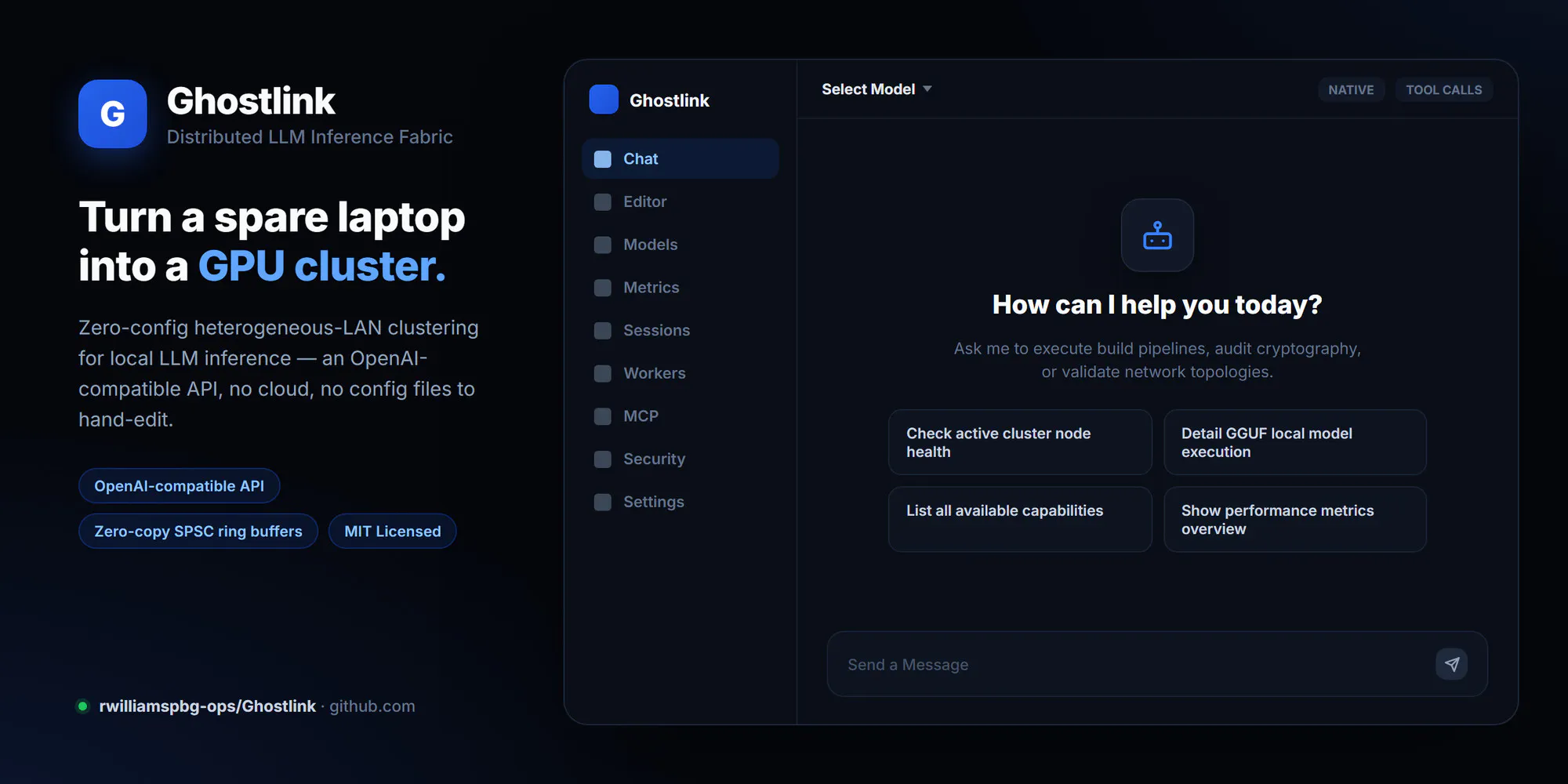 Ghostlink |  BUD |
|---|---|---|
| Primary Category | Design Tools | Design Tools |
| Community Rating | No ratings(0 reviews) | No ratings(0 reviews) |
| Community Upvotes | 11 votes | 7 votes |
| Supported Platforms | Web | Web |
| Tags & Focus | #GitHub#API#Design Tools | #Productivity#Design Tools#OpenAI Day#Sketch |
| Maker / Company | Independent Developer | Independent Developer |
| Platform Verification | Community Listing | Community Listing |
About Ghostlink
Ghostlink is a distributed Large Language Model (LLM) inference fabric designed to harness local, heterogeneous computing clusters. Built by developer Ryan Williams, Ghostlink enables developers and hardware enthusiasts to pool together diverse local devices to run heavy LLM workloads effectively.
Key technical features of Ghostlink include:
- Heterogeneous Cluster Support: Distribute local LLM inference across disparate hardware setups.
- Zero-Copy SPSC Ring Buffers: Utilizes Single-Producer Single-Consumer (SPSC) ring buffers to enable high-efficiency data passing with minimal memory overhead.
- Automated Tuning: Optimizes operational settings automatically across nodes in the cluster.
- OpenAI-Compatible API: Exposes an API endpoint compatible with standard OpenAI client libraries, allowing easy drop-in replacement for downstream applications.
Pros of Ghostlink
- Supports distributed LLM inference across heterogeneous local hardware
- Utilizes zero-copy SPSC ring buffers for optimized latency and data transport
- Provides automated tuning for efficient cluster operation
- Features an OpenAI-compatible API for seamless software integrations
Cons of Ghostlink
- Requires technical configuration to set up and manage across local nodes
- Primarily developer-focused with repository-based deployment
Frequently Asked Questions
What is Ghostlink?
Ghostlink is an open-source distributed LLM inference fabric designed to run local Large Language Models across heterogeneous clusters of computing devices.
Does Ghostlink integrate with existing OpenAI tools?
Yes, Ghostlink offers an OpenAI-compatible API, allowing applications built for OpenAI endpoints to seamlessly connect to your local Ghostlink cluster.
What performance features does Ghostlink use?
Ghostlink leverages zero-copy Single-Producer Single-Consumer (SPSC) ring buffers and automated tuning to optimize inference across your cluster.
Where can I find Ghostlink?
Ghostlink is hosted on GitHub under the repository rwilliamspbg-ops/Ghostlink.
About BUD
BUD is an innovative voice-first canvas designed specifically for sketchnoting, whiteboarding, and diagramming. By allowing users to speak naturally, BUD transforms spoken ideas into visual assets in real time, streamlining the journey from abstract thought to structured diagram.
Whether you are mapping out complex system architectures, outlining step-by-step flowcharts, or simply brainstorming, BUD bridges the gap between voice and visual creation. Built as a powerful productivity and design tool, it empowers creators, developers, and professionals to sketch and edit diagrams effortlessly without getting bogged down by manual drawing mechanics.
Pros of BUD
- Voice-first interface enables natural, hands-free idea generation
- Real-time visual creation for system architectures and flowcharts
- Streamlines sketching and whiteboarding workflows
- Turns verbal thoughts directly into editable diagrams
Cons of BUD
- Limited to features supported by the voice-first canvas model
- Requires spoken input which may not suit all working environments
- Relies entirely on real-time interpretation of voice commands
Frequently Asked Questions
What is BUD?
BUD is a voice-first canvas tool built for sketchnoting, whiteboarding, and diagramming, allowing users to build system architectures and flowcharts by speaking naturally.
What can I create using BUD?
You can ideate, sketch, and edit flowcharts, system architectures, and turn verbal ideas into visual diagrams in real time.