
G.I.A.ac vs Skeg
Comprehensive feature analysis, ratings breakdown, platform compatibility, and community review comparison.
G.I.A.ac
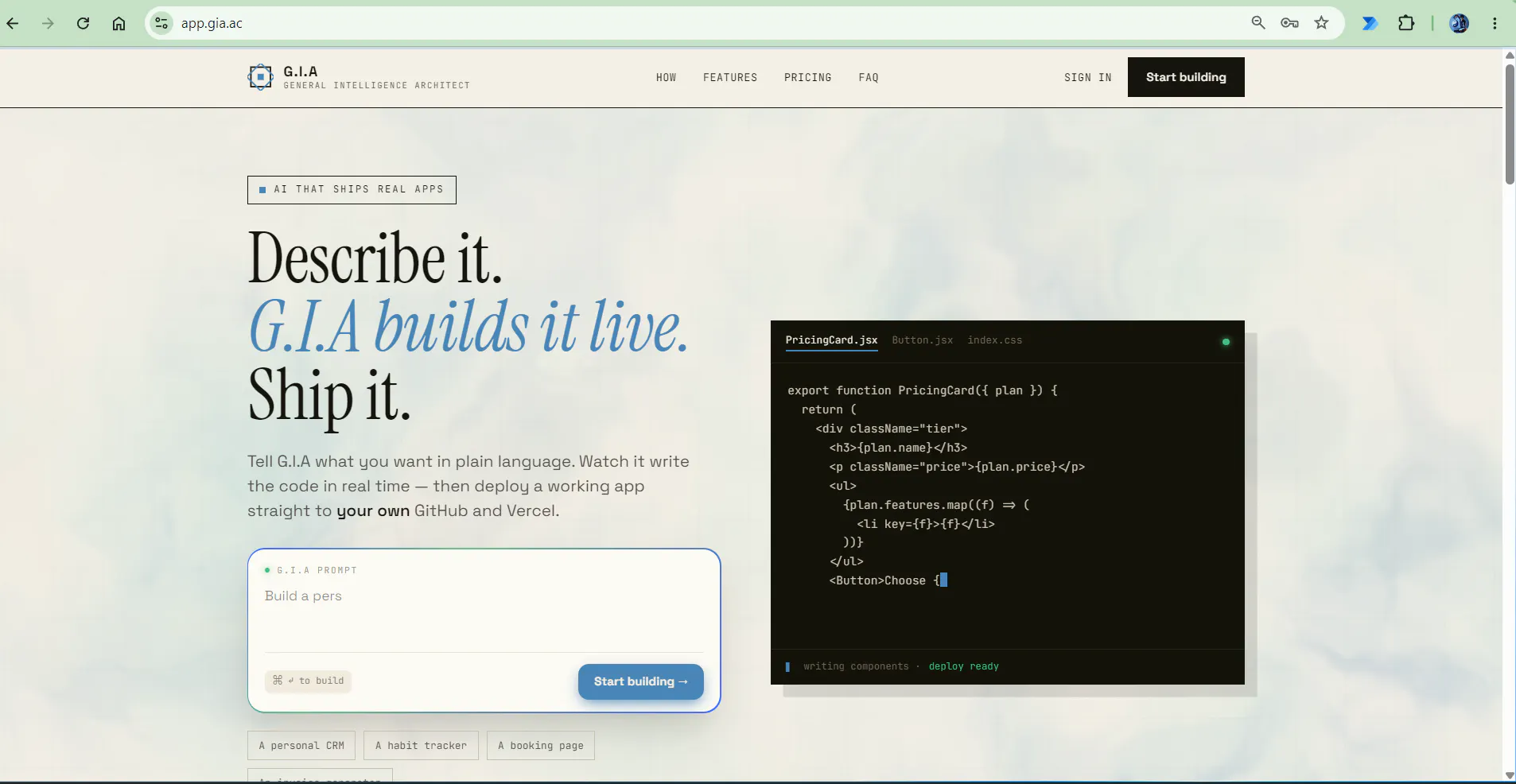
Build real, working apps from a single sentence
Detailed Feature Comparison Matrix
Compare Other Tools| Dimension | G.I.A.ac |  Skeg |
|---|---|---|
| Primary Category | Developer Tools | Developer Tools |
| Community Rating | No ratings(0 reviews) | No ratings(0 reviews) |
| Community Upvotes | 105 votes | 6 votes |
| Supported Platforms | Web | Web |
| Tags & Focus | #Developer Tools | #Artificial Intelligence#Developer Tools#Database |
| Maker / Company | Independent Developer | Independent Developer |
| Platform Verification | Community Listing | Community Listing |
About G.I.A.ac
G.I.A.ac (General Intelligence Architect) is an AI-powered developer tool designed to transform simple text prompts into functional applications. Developed by Elhoucine Idousaid, G.I.A.ac allows users to build real, working apps from just a single sentence prompt.
By describing your app concept in natural language, G.I.A.ac constructs the software live, enabling you to watch your application get built in real time. It serves as a rapid development tool for creators looking to turn software ideas into functional prototypes or working apps quickly.
Pros of G.I.A.ac
- Builds real, working applications from a single sentence prompt
- Live real-time application generation visual feedback
- Simplifies software creation using natural language input
- Designed to streamline developer workflows and prototyping
Cons of G.I.A.ac
- Information regarding exported code formats or framework details is not specified
- Pricing tiers and feature limitations are not explicitly provided in the launch details
Frequently Asked Questions
What is G.I.A.ac?
G.I.A.ac stands for General Intelligence Architect. It is an AI tool in the Developer Tools category designed to build functional applications live based on text descriptions.
How does G.I.A.ac build applications?
Users enter a text prompt describing their app concept, and G.I.A.ac processes the description and builds the working application live in real time.
Who developed G.I.A.ac?
G.I.A.ac was created by maker Elhoucine Idousaid.
About Skeg
Skeg is an open-source, multi-tenant vector database written in Rust, designed specifically to address memory constraints in vector storage. It is engineered for extreme RAM efficiency, allowing developers to pack significantly more vectors per gigabyte of memory without sacrificing search recall.
Purpose-built for high-density, many-tenant deployments, Skeg treats memory efficiency as a primary design consideration rather than an afterthought. This makes it an ideal database solution for infrastructure setups where RAM capacity is the critical bottleneck.
Pros of Skeg
- Extreme RAM efficiency to pack more vectors per GB
- Maintains high search recall
- Specifically optimized for high-density, multi-tenant deployments
- Open source and written in Rust for performance and safety
Cons of Skeg
- Focused primarily on memory-constrained vector use cases, which may be redundant for environments with abundant RAM
- No managed cloud hosting or commercial support options are mentioned in the metadata
Frequently Asked Questions
What is Skeg?
Skeg is an open-source, multi-tenant vector database written in Rust. It is designed to offer extreme RAM efficiency, allowing you to store more vectors per GB while maintaining high recall.
Who is Skeg built for?
Skeg is purpose-built for high-density, many-tenant deployments where server memory (RAM) is the primary constraint or bottleneck.
Is Skeg open source?
Yes, Skeg is open-source software and its repository is hosted on GitHub.