
ArgusAI vs Skeg
Comprehensive feature analysis, ratings breakdown, platform compatibility, and community review comparison.
ArgusAI
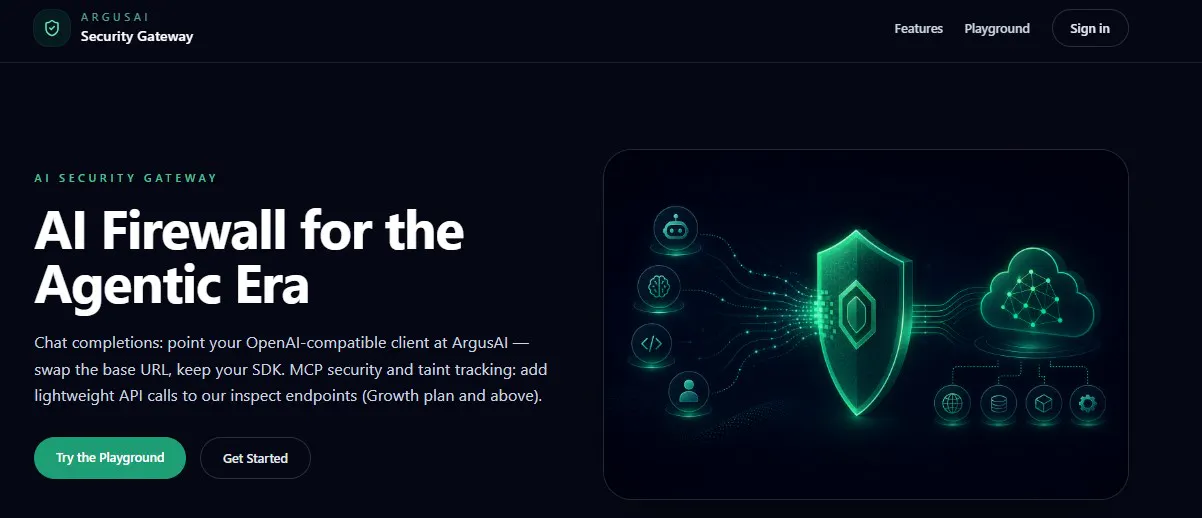
AI firewall for LLM calls, MCP tools, and agentic workflows
Detailed Feature Comparison Matrix
Compare Other Tools| Dimension | ArgusAI |  Skeg |
|---|---|---|
| Primary Category | Developer Tools | Developer Tools |
| Community Rating | No ratings(0 reviews) | No ratings(0 reviews) |
| Community Upvotes | 7 votes | 6 votes |
| Supported Platforms | Web | Web |
| Tags & Focus | #Artificial Intelligence#Developer Tools#Security | #Artificial Intelligence#Developer Tools#Database |
| Maker / Company | Independent Developer | Independent Developer |
| Platform Verification | Community Listing | Community Listing |
About ArgusAI
ArgusAI is an advanced AI firewall and plug-and-play security gateway designed specifically for agentic applications, LLM calls, and MCP tools. As AI workflows become more complex, securing sensitive data and preventing vulnerabilities is critical. ArgusAI protects your chat interfaces, Model Context Protocol (MCP) tools, and AI workflows seamlessly by allowing you to simply swap your OpenAI-compatible base URL—requiring zero SDK changes.
With ArgusAI, developers can actively detect and block prompt injection, jailbreaks, credential leaks, and PII exposure. The platform empowers teams to inspect tool inputs and outputs, track cross-tool taint, and enforce customizable block, flag, or redact policies. It offers robust support for major models including OpenAI, Anthropic, and Gemini, backed by comprehensive audit logs, real-time analytics, webhooks, and enterprise policy controls.
Pros of ArgusAI
- Plug-and-play setup with zero SDK changes required (just swap the OpenAI-compatible base URL)
- Comprehensive protection against prompt injections, jailbreaks, credential leaks, and PII exposure
- Advanced tool inspection, tracking cross-tool taint, and managing tool inputs/outputs
- Broad model support including OpenAI, Anthropic, and Gemini
- Built-in audit logs, real-time analytics, webhooks, and enterprise-grade policy controls
Cons of ArgusAI
- Relies on swapping base URLs, which may require configuration updates across various environments
- Specific advanced enterprise integrations or custom workflow rules beyond listed features are not explicitly detailed
- Primarily tailored for developer tools and agentic app security workflows
Frequently Asked Questions
What is ArgusAI?
ArgusAI is a plug-and-play AI security gateway and firewall designed to protect chat applications, MCP tools, and agentic workflows from threats like prompt injection, jailbreaks, credential leaks, and PII exposure.
How do I integrate ArgusAI into my application?
Integration is designed to be frictionless—you simply swap your OpenAI-compatible base URL without needing to make any SDK changes.
Which LLM providers does ArgusAI support?
ArgusAI supports major AI model providers including OpenAI, Anthropic, and Gemini.
What security features does ArgusAI offer?
It provides detection and blocking for prompt injections, jailbreaks, credential leaks, and PII exposure, alongside tool input/output inspection, cross-tool taint tracking, and block, flag, or redact policies.
About Skeg
Skeg is an open-source, multi-tenant vector database written in Rust, designed specifically to address memory constraints in vector storage. It is engineered for extreme RAM efficiency, allowing developers to pack significantly more vectors per gigabyte of memory without sacrificing search recall.
Purpose-built for high-density, many-tenant deployments, Skeg treats memory efficiency as a primary design consideration rather than an afterthought. This makes it an ideal database solution for infrastructure setups where RAM capacity is the critical bottleneck.
Pros of Skeg
- Extreme RAM efficiency to pack more vectors per GB
- Maintains high search recall
- Specifically optimized for high-density, multi-tenant deployments
- Open source and written in Rust for performance and safety
Cons of Skeg
- Focused primarily on memory-constrained vector use cases, which may be redundant for environments with abundant RAM
- No managed cloud hosting or commercial support options are mentioned in the metadata
Frequently Asked Questions
What is Skeg?
Skeg is an open-source, multi-tenant vector database written in Rust. It is designed to offer extreme RAM efficiency, allowing you to store more vectors per GB while maintaining high recall.
Who is Skeg built for?
Skeg is purpose-built for high-density, many-tenant deployments where server memory (RAM) is the primary constraint or bottleneck.
Is Skeg open source?
Yes, Skeg is open-source software and its repository is hosted on GitHub.