
ArgusAI vs Role model AI
Comprehensive feature analysis, ratings breakdown, platform compatibility, and community review comparison.
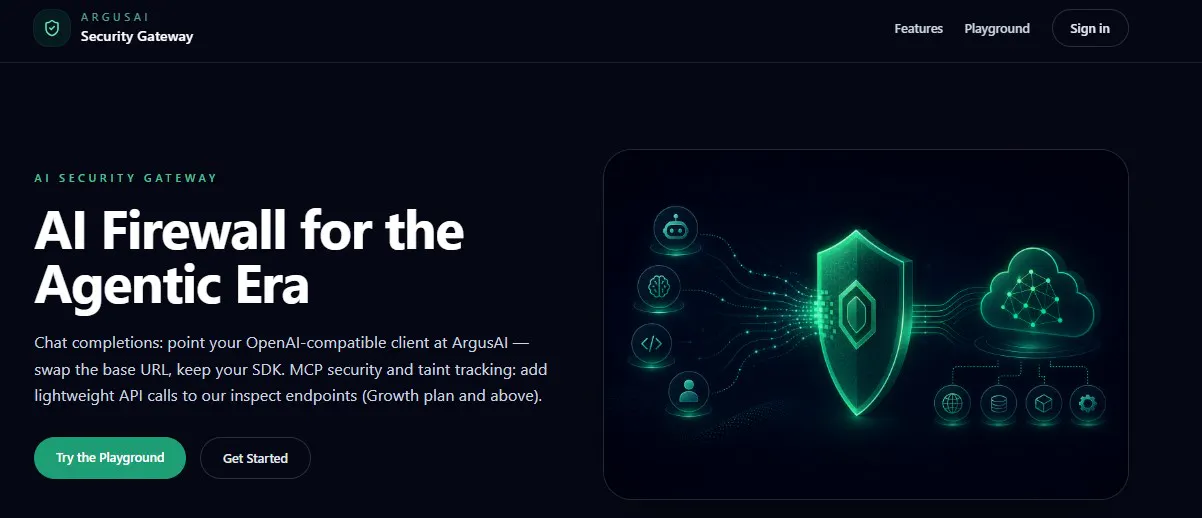
ArgusAI
AI firewall for LLM calls, MCP tools, and agentic workflows
Detailed Feature Comparison Matrix
Compare Other Tools| Dimension | ArgusAI |  Role model AI |
|---|---|---|
| Primary Category | Developer Tools | Developer Tools |
| Community Rating | No ratings(0 reviews) | No ratings(0 reviews) |
| Community Upvotes | 7 votes | 7 votes |
| Supported Platforms | Web | Web |
| Tags & Focus | #Artificial Intelligence#Developer Tools#Security | #Artificial Intelligence#Developer Tools#Vibe coding |
| Maker / Company | Independent Developer | Independent Developer |
| Platform Verification | Community Listing | Community Listing |
About ArgusAI
ArgusAI is an advanced AI firewall and plug-and-play security gateway designed specifically for agentic applications, LLM calls, and MCP tools. As AI workflows become more complex, securing sensitive data and preventing vulnerabilities is critical. ArgusAI protects your chat interfaces, Model Context Protocol (MCP) tools, and AI workflows seamlessly by allowing you to simply swap your OpenAI-compatible base URL—requiring zero SDK changes.
With ArgusAI, developers can actively detect and block prompt injection, jailbreaks, credential leaks, and PII exposure. The platform empowers teams to inspect tool inputs and outputs, track cross-tool taint, and enforce customizable block, flag, or redact policies. It offers robust support for major models including OpenAI, Anthropic, and Gemini, backed by comprehensive audit logs, real-time analytics, webhooks, and enterprise policy controls.
Pros of ArgusAI
- Plug-and-play setup with zero SDK changes required (just swap the OpenAI-compatible base URL)
- Comprehensive protection against prompt injections, jailbreaks, credential leaks, and PII exposure
- Advanced tool inspection, tracking cross-tool taint, and managing tool inputs/outputs
- Broad model support including OpenAI, Anthropic, and Gemini
- Built-in audit logs, real-time analytics, webhooks, and enterprise-grade policy controls
Cons of ArgusAI
- Relies on swapping base URLs, which may require configuration updates across various environments
- Specific advanced enterprise integrations or custom workflow rules beyond listed features are not explicitly detailed
- Primarily tailored for developer tools and agentic app security workflows
Frequently Asked Questions
What is ArgusAI?
ArgusAI is a plug-and-play AI security gateway and firewall designed to protect chat applications, MCP tools, and agentic workflows from threats like prompt injection, jailbreaks, credential leaks, and PII exposure.
How do I integrate ArgusAI into my application?
Integration is designed to be frictionless—you simply swap your OpenAI-compatible base URL without needing to make any SDK changes.
Which LLM providers does ArgusAI support?
ArgusAI supports major AI model providers including OpenAI, Anthropic, and Gemini.
What security features does ArgusAI offer?
It provides detection and blocking for prompt injections, jailbreaks, credential leaks, and PII exposure, alongside tool input/output inspection, cross-tool taint tracking, and block, flag, or redact policies.
About Role model AI
Role Model AI is an innovative AI agent avatar platform designed to help individuals and businesses build intelligent digital teammates equipped with unique identities, specific expertise, and persistent memory. Developed by founder & CEO Milan Cheeks (SELF Labs), the platform bridges the gap between basic chatbots and collaborative workflows by offering over 100+ pre-built specialist avatars alongside custom avatar creation capabilities.
Unlike traditional conversational tools, Role Model AI agents are built to take action. They can chat, integrate directly into Zoom meetings, connect to external tools through MCP (Model Context Protocol), and collaborate seamlessly as a team of AI agents. Whether you are focused on software development, vibe coding, research, or general daily productivity, Role Model AI helps automate complex, multi-step workflows with minimal human input.
Pros of Role model AI
- Create custom AI agent avatars or choose from a library of over 100+ pre-built specialists.
- Agents feature persistent memory, unique identities, and specialized expertise.
- Capable of joining live Zoom meetings and taking action.
- Connects to tools through MCP (Model Context Protocol) and supports multi-agent collaboration.
- Useful for a wide range of tasks including coding, research, vibe coding, and everyday productivity.
Cons of Role model AI
- Specific pricing tiers and subscription details are not provided in the platform data.
- Relies on external platform ecosystems like Zoom and MCP tool connections for its advanced capabilities.
- A niche understanding of multi-agent orchestration may be required to maximize team collaboration features.
Frequently Asked Questions
What is Role Model AI?
Role Model AI is an AI agent avatar platform that allows users to build or select intelligent digital teammates with unique identities, expertise, and memory to automate work, coding, research, and productivity.
Can Role Model AI agents join live meetings?
Yes, Role Model AI agents have the capability to join Zoom meetings, chat, and take action alongside users.
How do Role Model AI agents connect with other tools?
The platform connects agents to various tools through MCP (Model Context Protocol), enabling them to collaborate as teams and execute multi-step workflows.
Who created Role Model AI?
Role Model AI was created by Milan Cheeks, Founder & CEO at SELF Labs.